By HAN News Desk
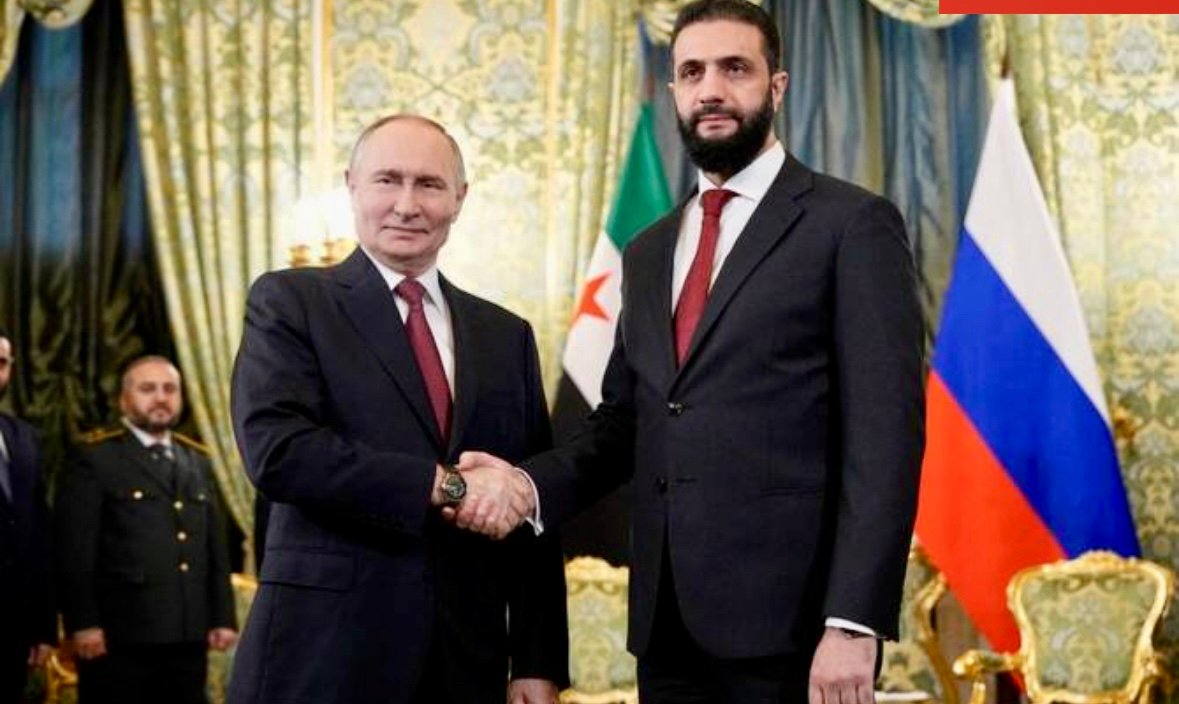
MOSCOW — Russian President Vladimir Putin on Wednesday hosted Syria’s interim president, Ahmed Al-Sharaa, for talks expected to focus heavily on the future of Russia’s military presence in Syria, including its key naval and air bases along the Mediterranean coast.
The visit marks Al-Sharaa’s second trip to Moscow in less than four months. He first traveled to Russia in October, shortly before leading a swift military offensive in December 2024 that toppled longtime Syrian leader Bashar Assad. Assad, who had relied on Russian military backing throughout much of Syria’s nearly 14-year civil war, fled the country as opposition forces advanced. Russia later granted asylum to Assad and his family.
Despite being preoccupied with its war in Ukraine and maintaining only a limited military contingent in Syria in recent years, Moscow did not intervene to stop the offensive that removed Assad from power. The Kremlin has since sought to recalibrate its relationship with Syria’s new leadership.
Although Russia and Al-Sharaa’s forces were on opposing sides during much of the civil war, the interim government in Damascus has signaled a willingness to engage with Moscow. Analysts say the new Syrian leadership appears to view Russia as a potential partner in rebuilding the war-ravaged country and as a counterbalance to Western and regional powers, allowing Damascus to diversify its foreign policy ties.
For Russia, maintaining its military foothold in Syria remains a strategic priority. The country’s naval facility in Tartus and the Hmeimim air base near Latakia are Moscow’s only permanent military outposts outside the former Soviet Union. These bases are critical to sustaining Russia’s military reach in the Mediterranean and projecting influence across the Middle East and North Africa.
Russian officials have repeatedly expressed hope of securing agreements that would allow continued use of both facilities. Kremlin spokesman Dmitry Peskov said ahead of the meeting that “all issues related to our military’s presence in Syria will be discussed in the talks,” underscoring the importance Moscow places on the issue.
The talks come as Russia adjusts its military posture inside Syria. In recent days, Russian forces have begun withdrawing from several positions in northeastern Syria, an area still controlled by the Kurdish-led Syrian Democratic Forces, following the group’s loss of much of its territory during an offensive by Syrian government forces.
The outcome of the Moscow talks could shape the future of Russia’s role in Syria and signal how the country’s new leadership intends to balance relations with former adversaries as it seeks stability after years of conflict.