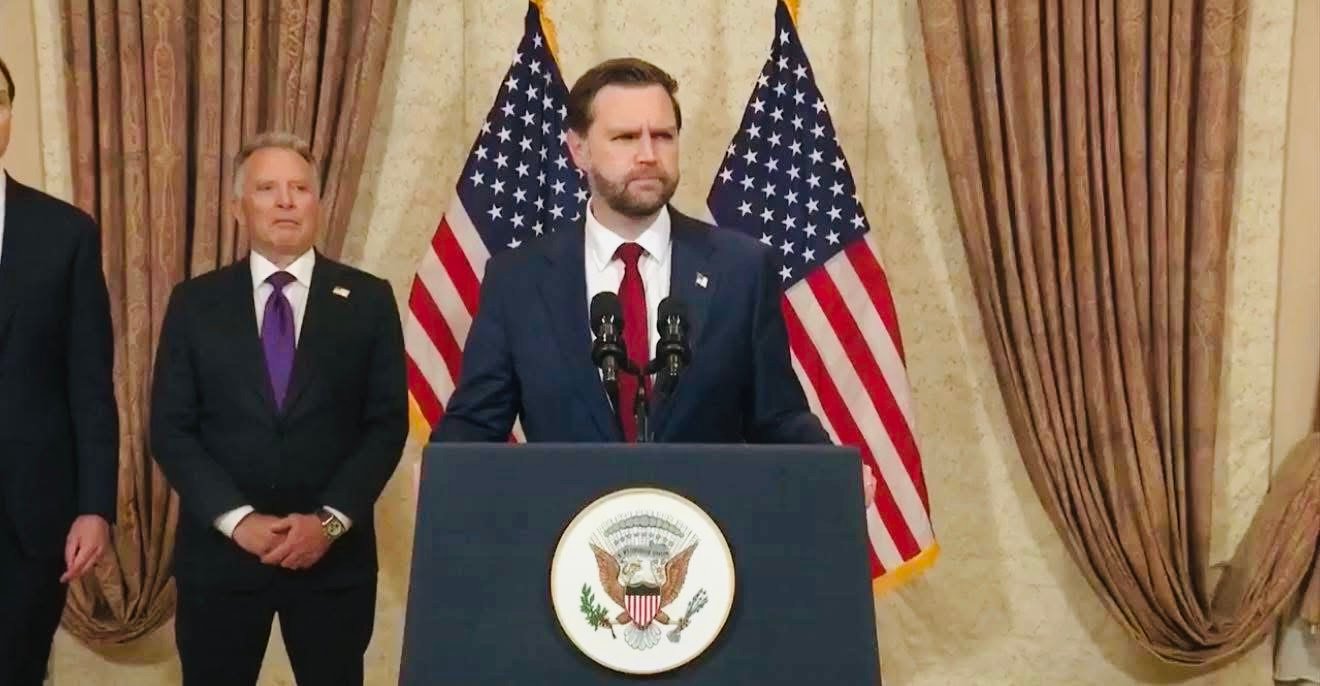
WASHINGTON — US Vice President J.D. Vance said that Iran has not yet provided a clear commitment to abandon its pursuit of nuclear weapons, underscoring that such assurances remain central to Washington’s diplomatic strategy amid renewed international concern over Tehran’s nuclear ambitions.
Speaking to reporters before departing Pakistan, Vance said the United States is seeking firm, verifiable, and long-term guarantees that Iran will not develop nuclear weapons under any circumstances.
“The reality is that we need to see a clear commitment from Iran that it does not want to obtain a nuclear weapon and is not seeking a pathway to acquire one quickly,” Vance said.
He stressed that the issue goes beyond short-term assurances, calling for a durable commitment that would extend well into the future. According to Vance, the demand reflects the core objective of the current US administration’s foreign policy in its engagement with Tehran.
“This is the primary objective of the US president, and it is what we expect from these negotiations,” he said.
Vance also raised doubts about Iran’s willingness to provide such guarantees, noting that previous diplomatic efforts have struggled to secure lasting commitments.
“Will we see a genuine commitment from the Iranians not just now or in the next couple of years, but over the long term that they will not build a nuclear weapon? We have not seen that yet. We hope to see it,” he added.
The comments come as efforts to revive diplomacy around Iran’s nuclear program continue, following years of tension after the collapse of the Joint Comprehensive Plan of Action — a landmark 2015 agreement between Iran and world powers designed to limit Tehran’s nuclear activities in exchange for sanctions relief.
Since then, Western officials have accused Iran of expanding its uranium enrichment activities beyond agreed limits, while Tehran insists its nuclear program is for peaceful purposes, including energy production and medical research.
The International community, including the International Atomic Energy Agency, has repeatedly called for transparency and cooperation from Iran, warning that unresolved issues could further heighten regional tensions.
Analysts say Washington is now pushing for a broader and more durable framework than the original deal, one that would address not only nuclear restrictions but also verification mechanisms and long-term compliance.
Vance did not provide details on the timeline or structure of any potential agreement but indicated that diplomatic channels remain open, even as skepticism persists.
The remarks highlight ongoing challenges in efforts to curb nuclear proliferation in the Middle East, a region already strained by geopolitical rivalries and security concerns.