
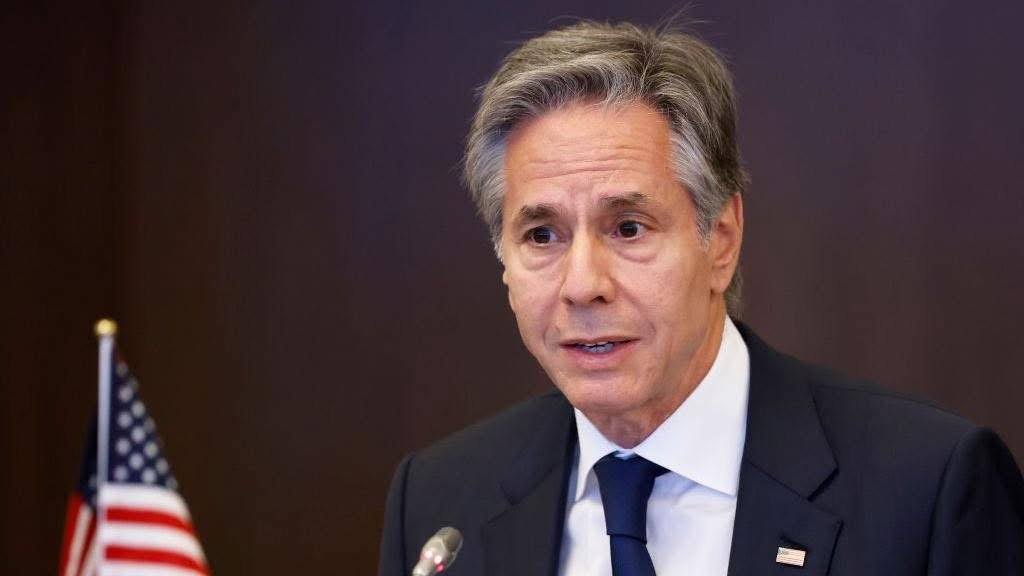
WASHINGTON — Antony Blinken has acknowledged that United States cannot effectively compete alone against the growing economic and industrial power of China, warning that Beijing’s expanding influence poses one of the greatest strategic challenges facing Washington.
Speaking during a discussion on global competition and international alliances, Blinken said China’s vast domestic market, manufacturing strength and technological advances have transformed the balance of global power.
“If the United States competes directly with China alone, there is a possibility we could lose,” Blinken said.
“China’s market is larger than that of the United States, and its industrial production is roughly three times greater. They have enormous purchasing power, significant research capacity, innovation and advanced technology,” he added.
The remarks reflect growing concern among American policymakers over China’s rapid economic rise and its increasing influence across trade, technology, infrastructure and geopolitics.
Over the past two decades, China has emerged as the world’s second-largest economy and a dominant force in global manufacturing, while also expanding investments across Africa, Asia, Latin America and the Middle East through major infrastructure and trade initiatives.
Blinken argued, however, that Washington retains a major advantage when working alongside its allies and strategic partners.
He said cooperation between the United States and partners including Japan, South Korea, India, Australia, Canada and European nations could create a combined economic bloc representing more than half of the global economy.
“When America works together with Europe, Japan, South Korea, India, Australia and Canada, the combined economic power reaches around 50 to 60 percent of the world economy,” Blinken said.
“That is something China finds very difficult to compete with.”
Analysts say the comments highlight a broader shift in US foreign policy toward strengthening alliances to counter Beijing’s growing global influence.
Successive American administrations have increasingly focused on deepening strategic ties with allies in the Indo-Pacific region, amid concerns over China’s expanding military capabilities, technological dominance and economic reach.
Relations between Washington and Beijing have become increasingly tense in recent years over issues including trade disputes, advanced semiconductor technology, Taiwan, the South China Sea and global supply chains.
Despite the rivalry, both countries remain deeply interconnected economically, with bilateral trade and financial ties continuing to play a major role in the global economy.
The competition between the United States and China is widely seen as one of the defining geopolitical struggles of the 21st.