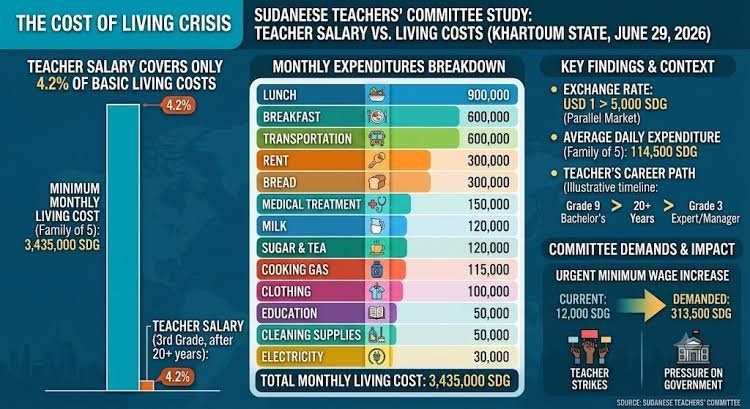
KHARTOUM — A study published by the Sudanese Teachers’ Committee on Monday has found that the average salary of a teacher in Sudan covers just 4.2% of basic monthly living costs, underscoring a deepening cost-of-living crisis amid currency depreciation and economic instability.
The report said the findings highlight an urgent need to revise public sector wages, as inflation and currency collapse continue to erode purchasing power across the country.
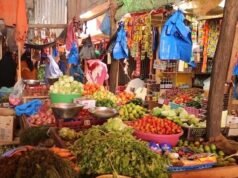
According to the study, the minimum cost of living for a family of five in Khartoum State has risen to about 3.43 million Sudanese pounds per month, driven by sharp increases in food, housing, transport and healthcare costs.
It added that a third-grade teacher’s salary—typically reached after more than two decades of service—covers only a small fraction of these expenses, reflecting what it described as a widening gap between wages and basic needs.
The committee linked the crisis to the continued decline of the Sudanese pound on parallel markets, where the US dollar is reportedly trading above 5,000 pounds, further accelerating inflationary pressures.
The study broke down average monthly household expenses, including about 900,000 pounds for lunch, 600,000 for breakfast, 600,000 for transport, and 300,000 for rent and bread respectively. Additional costs include medical care, education, utilities, and basic household necessities.
Civil service pay scales in Sudan start at the 17th grade for manual workers, while university graduates enter at the ninth grade. Employees typically progress over decades to higher ranks, with senior “third-grade” positions reserved for experienced professionals and administrators.
Teachers, according to the report, often reach this level only after more than 20 years of service, despite remaining on low salaries that the committee says are no longer sufficient to meet basic living standards.
The committee called for urgent salary adjustments and broader economic reforms to address what it described as a worsening humanitarian and social crisis affecting public sector workers.
The findings come as Sudan continues to face conflict, economic contraction, and deteriorating public services across multiple states.