
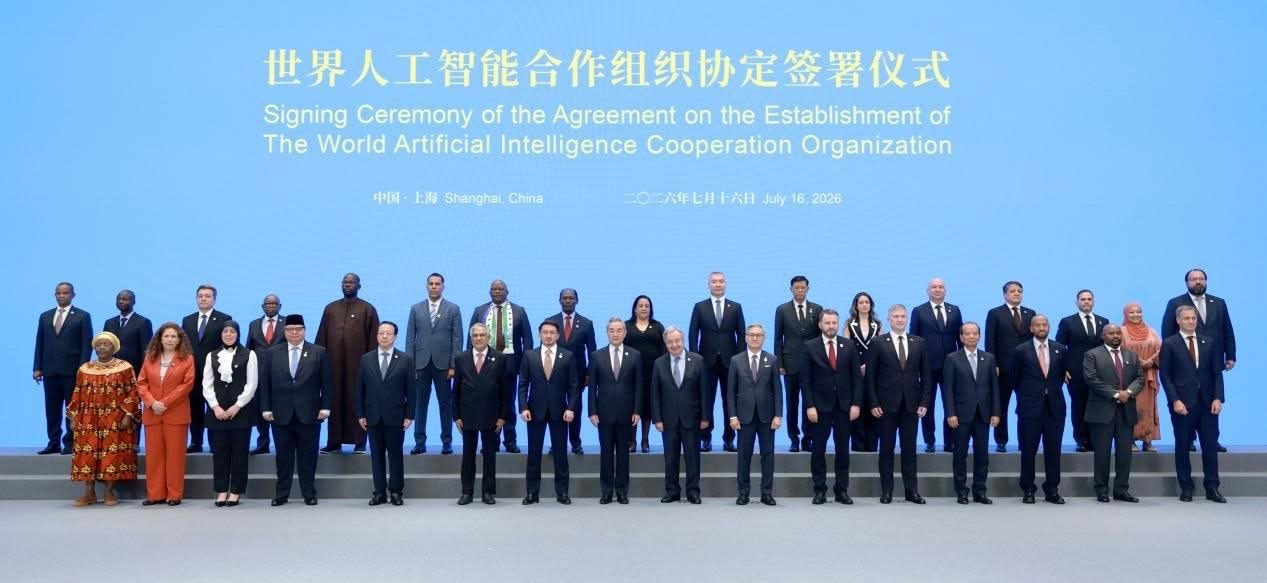
SHANGHAI — Twenty-nine countries have signed an agreement in Shanghai to establish the World Artificial Intelligence Cooperation Organization (WAICO), a new international institution designed to strengthen global cooperation on the development and governance of artificial intelligence.
The agreement was reached during a major international conference on artificial intelligence, bringing together representatives from participating countries to discuss the future of AI technology and the need for greater coordination among governments.
If formally established, WAICO would become the world’s first intergovernmental organisation dedicated specifically to artificial intelligence cooperation, creating a platform for countries to collaborate on AI research, innovation, regulation and responsible use.
The organisation is expected to support cooperation in several key areas, including AI technology development, scientific research, ethical standards, safety frameworks, digital infrastructure, data management and international knowledge-sharing.
Supporters of WAICO said the organisation will help countries address common challenges linked to the rapid expansion of AI, including the risks of misinformation, cyber threats, privacy violations, algorithmic bias and the unequal distribution of advanced technologies.
The initiative comes at a time when artificial intelligence is transforming major sectors worldwide, including medicine, education, agriculture, finance, manufacturing, transportation and government services. Many countries are seeking ways to benefit from AI while ensuring that the technology develops in a safe and responsible manner.
Participating nations said global cooperation is necessary because AI development crosses national borders and requires shared approaches to issues such as technology standards, security, research partnerships and digital governance.
The establishment of WAICO also highlights growing efforts by emerging economies to participate more actively in shaping global AI policies rather than relying only on decisions made by major technology powers.
The organisation is expected to provide a forum where member states can exchange expertise, promote joint research projects and support capacity-building programmes, particularly for countries seeking to strengthen their AI capabilities.
However, experts note that WAICO will face challenges, including differences among countries over AI regulations, data policies, technological competition and the balance between innovation and security.
Further discussions are expected to determine WAICO’s permanent headquarters, leadership structure, membership requirements and operational framework as the organisation moves toward formal creation.
The agreement represents another step in the growing international effort to create a coordinated approach to one of the most influential technologies of the 21st century.