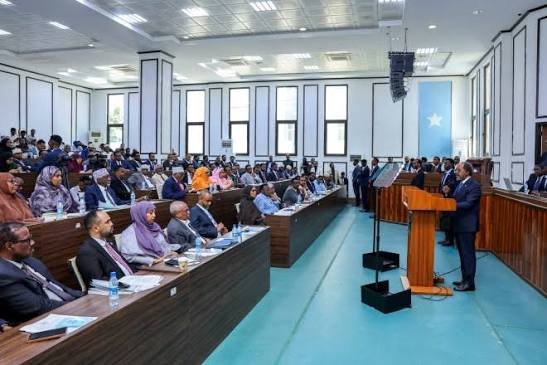
MOGADISHU — Somali President Hassan Sheikh Mohamud on Saturday officially inaugurated the Eighth Session of the 11th Federal Parliament, calling on lawmakers to intensify their legislative work, strengthen democratic institutions, and support the country’s ongoing security, constitutional, and political transformation.
The opening ceremony took place during a joint sitting of the House of the People and the Upper House at Villa Hargeisa in Mogadishu, marking Parliament’s return from recess and the beginning of a new legislative period expected to address several critical national priorities.
The new session also paves the way for the election of a new Speaker of the House of the People following the resignation of Sheikh Aden Mohamed Nur (Aden Madobe), who stepped down after winning the presidency of Southwest State. The leadership vote is expected to shape Parliament’s direction as lawmakers prepare to deliberate on key constitutional, electoral, security, and governance reforms.
In his address, President Hassan Sheikh commended members of both chambers for their contributions to Somalia’s state-building process, praising Parliament’s role in passing important legislation, overseeing government performance, strengthening accountability, and representing the interests of the Somali people.
“You have played an important role in building the country, strengthening the accountability of government institutions, developing laws that serve the national interest, and representing the Somali people,” the president told lawmakers.
The president outlined his administration’s priorities for the coming months, emphasizing the importance of maintaining momentum in the fight against al-Shabab, accelerating institutional reforms, improving public service delivery, and creating conditions for sustainable economic growth.
He said Somalia has made measurable progress in restoring security through coordinated military operations led by the Somali National Army, supported by local community defense forces and international partners. According to the president, government forces continue to reclaim territory previously controlled by al-Shabab, allowing civil authorities to gradually restore governance, reopen essential public services, and facilitate humanitarian assistance in liberated areas.
Hassan Sheikh reaffirmed that defeating terrorism remains one of his government’s highest priorities, stressing that military operations will continue until extremist groups no longer pose a threat to Somalia’s peace, stability, and development.
The president also reiterated his administration’s commitment to implementing a one-person, one-vote electoral system, describing universal suffrage as a cornerstone of Somalia’s democratic future. He argued that direct elections would expand political participation, strengthen public confidence in state institutions, improve government accountability, and allow Somali citizens to directly elect their leaders for the first time in decades.
He urged political leaders, federal member states, and all national stakeholders to work together in pursuit of consensus, emphasizing that unity and dialogue are essential for achieving lasting peace and completing Somalia’s democratic transition.
Beyond security and elections, Hassan Sheikh highlighted the government’s broader development agenda, including expanding economic opportunities, attracting investment, strengthening public institutions, improving education and healthcare, and creating employment opportunities for Somalia’s growing youth population. He said lasting peace must be accompanied by inclusive development that benefits communities across the country.
The president also called on lawmakers to continue advancing legislation needed to complete the provisional constitution, modernize Somalia’s legal framework, strengthen federal institutions, and support the country’s long-term governance reforms.
The Eighth Session opens at a critical time for Somalia as the country navigates several major political and security challenges. Parliament is expected to consider legislation related to constitutional amendments, electoral laws, federal governance, national security, and institutional reforms while overseeing the government’s implementation of key national priorities.
The session also comes amid continued military operations against al-Shabab and ongoing discussions over the future of the African Union Support and Stabilization Mission in Somalia (AUSSOM), whose long-term funding and mandate remain under international review.
Political observers say the decisions taken during this parliamentary session—including the election of a new House Speaker and progress on constitutional and electoral reforms—will play a significant role in shaping Somalia’s political trajectory ahead of future national elections and the country’s broader efforts to consolidate peace, strengthen democratic governance, and complete its state-building process.
If you’d like, I can also rewrite this in an AFP-style international news report suitable for publication by a news agency.