STRASBOURG — The European Union has opened the door to an unprecedented new relationship with Canada, with European Commission President Ursula von der Leyen announcing that Brussels wants to work with Ottawa toward making Canada the bloc’s first-ever “associate member.”
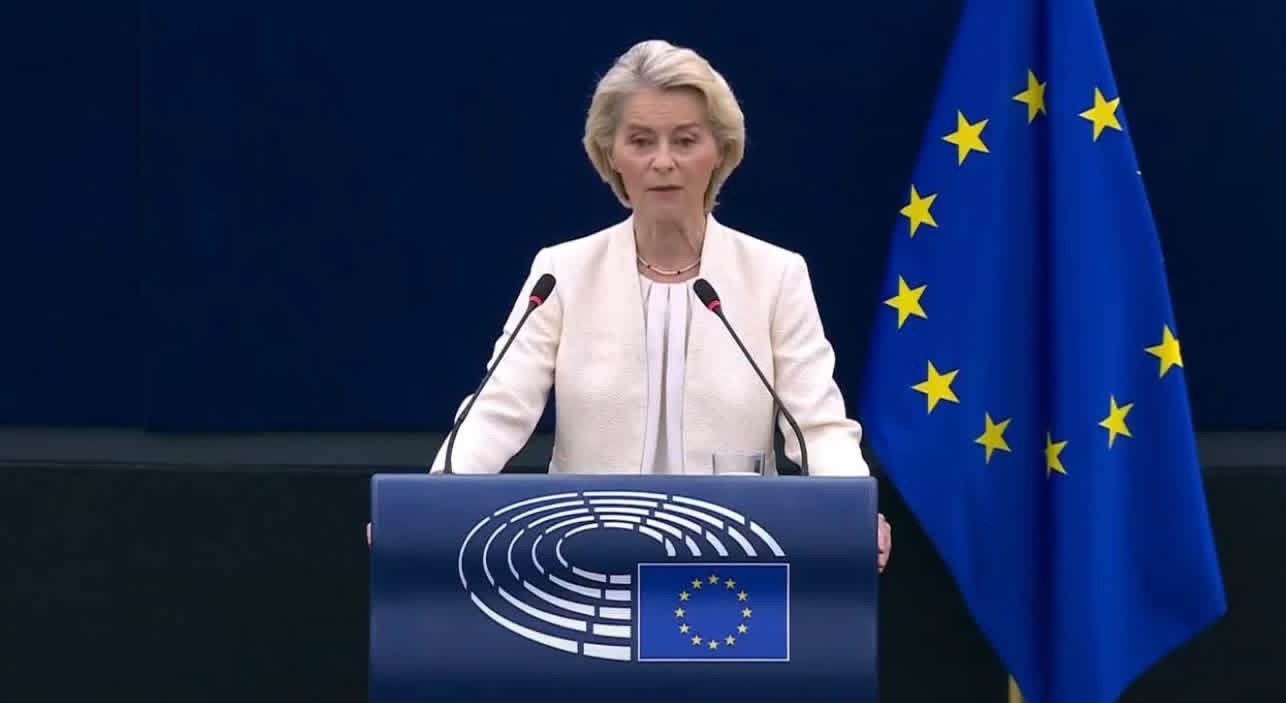
Von der Leyen made the announcement on Wednesday during her annual State of the European Union address at the European Parliament in Strasbourg, where Canadian Prime Minister Mark Carney was in attendance.
The proposal would not make Canada a full member of the 27-nation European Union. Instead, it would establish a new and deeper form of political, economic and strategic partnership between the EU and a country outside Europe.
Von der Leyen said Europe and Canada share common democratic values, interests and a similar understanding of the changing international environment. She highlighted areas including defence, artificial intelligence, climate policy, critical raw materials, energy, trade and geopolitics as potential pillars of a stronger partnership.
“We share one ocean, one set of values, one way of seeing the world,” von der Leyen said while addressing Carney and European lawmakers.
She proposed moving beyond the existing Canada-EU trade relationship toward what she described as an “Alliance for the Future”, designed to create a broader common space for economic prosperity and security.
A New Category for a Non-European Country
The proposed associate-member status would be significant because such a category does not currently exist in the EU treaties.
Canada therefore would not simply be joining an established EU membership framework. Brussels and Ottawa would have to determine what rights, obligations and institutional arrangements an associate relationship would include. The details remain subject to negotiations and possible legal changes.
The arrangement could potentially provide Canada with deeper access to European economic and strategic initiatives without giving it the same status as an EU member state.
Questions remain over issues such as market access, regulatory alignment, mobility, defence cooperation, participation in EU programmes and the extent to which Canada would have a role in European decision-making.
Canada Is Seeking a “Unique Alliance”
The announcement follows several weeks of increasingly close contacts between Ottawa and Brussels.
Prime Minister Mark Carney has said Canada is not seeking full EU membership, but instead wants what he calls a “unique alliance” with Europe.
Carney has argued that Canada and European countries share democratic values, economic interests and security concerns and can work together more closely at a time of growing geopolitical uncertainty.
His government has also been pursuing a strategy of diversifying Canada’s international economic relationships.
According to the Canadian government, the EU was Canada’s second-largest trading partner for goods and services in 2025, with two-way trade worth approximately C$178 billion. EU investment in Canada was estimated at about C$217 billion, while Canadian direct investment in the EU reached approximately C$315 billion.
These economic links provide an existing foundation for the proposed expansion of relations.
Defence and Security Cooperation
Security and defence are expected to be among the most important areas of the emerging partnership.
Canada already joined the EU’s Security Action for Europe (SAFE) initiative in February 2026, becoming the first non-European country to participate in the programme. Ottawa and Brussels also signed a Security and Defence Partnership in 2025, establishing a framework for closer cooperation with EU member states.
Potential future cooperation could include defence manufacturing, military technology, cybersecurity, intelligence-related cooperation, Arctic security and supply chains for strategic materials.
The Arctic is particularly important because Canada possesses extensive Arctic territory while several European countries have growing strategic and security interests in the region.
Critical Minerals, Energy and Technology
Economic security is another major element of the proposed relationship.
Canada possesses significant resources of critical minerals, which are increasingly important for batteries, electric vehicles, renewable-energy technologies, advanced manufacturing and defence industries.
The EU, meanwhile, is seeking to diversify its sources of strategic materials and reduce vulnerabilities in global supply chains.
Cooperation could also expand in areas such as hydrogen, nuclear energy, artificial intelligence, supercomputing, digital infrastructure and clean technology. Canadian and European officials have already identified several of these areas as potential areas for deeper cooperation.
The United States Factor
The announcement comes against the backdrop of increasingly difficult economic relations between Canada and the United States.
The United States remains Canada’s dominant economic partner, but trade tensions between Ottawa and Washington have encouraged the Canadian government to seek greater diversification.
Carney has emphasized that closer relations with Europe are part of a broader Canadian strategy to strengthen the country’s economic and strategic independence rather than simply replacing the United States with another partner.
For the EU, meanwhile, a deeper relationship with Canada would strengthen ties with a major democratic economy and NATO member in North America.
Von der Leyen has framed the initiative as a partnership for mutual strength and prosperity, rather than an alliance directed against another country.
Existing Trade Agreement Provides Foundation
Canada and the EU already have a major trade framework through the Comprehensive Economic and Trade Agreement (CETA).
However, the agreement has not yet been fully ratified by every EU member state, meaning parts of the broader economic relationship remain subject to limitations.
The proposed associate relationship could therefore represent an attempt to move beyond traditional trade cooperation and establish a much wider framework encompassing economic security, technology, defence and political cooperation.
EU officials and diplomats have nevertheless raised questions about how far such a new arrangement could realistically go and whether existing agreements should first be fully implemented.
October Summit Could Be Important
The next major opportunity to develop the proposal will come at the Canada-EU Summit in Montreal on October 29–30, 2026, according to the Canadian government.
The summit is expected to provide an opportunity for both sides to discuss trade, investment, security, technology and the future structure of their relationship.
However, the associate-membership proposal is still at an early stage. There is currently no established EU legal framework for such a status, and negotiations would need to determine exactly what membership would mean in practice.
A Potential New Model for EU Partnerships
If the initiative eventually becomes reality, Canada could become the first non-European country to receive an associate-member status within the EU, potentially creating a new model for relations between Brussels and countries that share European interests and values without being geographically part of Europe.
For Canada, the arrangement could offer deeper access to European economic, technological and security networks.
For the EU, it could provide a stronger partnership with a major North American democracy with extensive natural resources, advanced technology, Arctic territory and defence capabilities.
But the proposal remains a political initiative rather than an established membership arrangement. Its final form, legal basis and practical benefits will depend on negotiations between Canada, the European Commission, EU member states and other European institutions in the months ahead.
The announcement nevertheless marks a significant new chapter in Canada-EU relations, transforming what has traditionally been a trade and diplomatic partnership into a discussion about a much deeper strategic relationship.