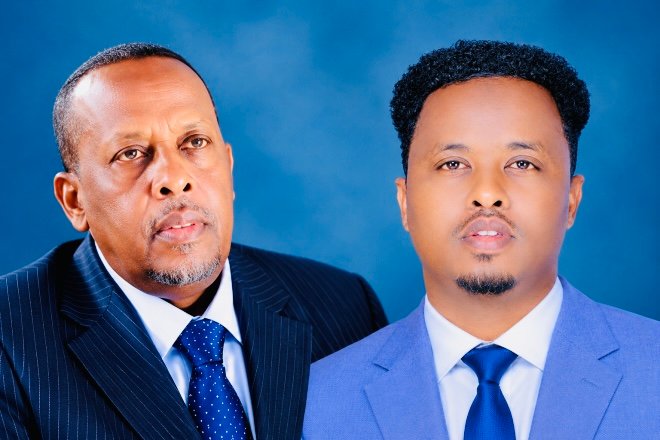
HARGEISA — A regional court in Somaliland has sentenced politician Abdikadir Mohamed Sharaay to one year in prison and Horn Cable TV journalist Abdirahman Mohamed Egeh to three months in prison following a controversial political interview in which Sharaay announced his intention to run for Somalia’s presidency in the 2027 elections.
The verdict was delivered on Monday, November 16, by the Maroodi Jeex Regional Court in Hargeisa, following the arrests of the two men in October. Both had remained in detention pending the conclusion of their court proceedings.
The case has attracted considerable attention because it involves two highly sensitive issues in Somaliland: the question of political sovereignty and the freedom of journalists to interview political figures and report on matters of public interest.
Politician Arrested After Announcing Presidential Ambitions
Abdikadir Mohamed Sharaay was arrested on October 16, shortly after appearing in an interview broadcast by Horn Cable TV, during which he publicly declared his intention to contest Somalia’s presidential election in 2027.
His announcement generated significant political controversy in Somaliland, where the question of independence from Somalia remains a central national and political issue.
During the interview, Sharaay argued that Somaliland should pursue international recognition through negotiations and diplomatic engagement with Mogadishu rather than relying primarily on Israel or other foreign governments.
His remarks sparked heated discussions on social media and among political commentators. Some politicians and public figures criticized his position and called on Somaliland authorities to take action against him.
Journalist Sentenced for Conducting the Interview
Horn Cable TV journalist Abdirahman Mohamed Egeh, who conducted the interview, was arrested on October 22 after responding to a summons from Somaliland’s Criminal Investigation Department.
His detention raised serious concerns among press freedom advocates, particularly because the journalist’s involvement in the case stemmed from conducting an interview with a politician discussing his political ambitions.
The three-month prison sentence has renewed questions about whether journalists in Somaliland can freely interview political figures and cover controversial political issues without facing criminal prosecution.
Sharaay Maintains Support for Somaliland’s Independence
During court proceedings, Sharaay maintained that he supported Somaliland’s statehood and recognized Somaliland and Somalia as two separate and independent countries.
He reportedly presented evidence demonstrating that he had previously expressed the same political position.
His defence raises important questions about the distinction between advocating political participation in Somalia’s electoral process and opposing Somaliland’s claim to independence.
However, the specific criminal charges brought against Sharaay, the legal provisions used by the court and the detailed reasoning behind his conviction were not immediately made public.
It also remained unclear whether Sharaay or Egeh intended to appeal their sentences.
CPJ Previously Condemned Journalist’s Detention
The journalist’s arrest had already attracted international attention.
On October 28, the Committee to Protect Journalists (CPJ) called for Egeh’s immediate and unconditional release, arguing that his detention represented a serious threat to press freedom.
CPJ said Egeh had been detained without charge for nearly a week and had been questioned about the interview he conducted with Sharaay.
Muthoki Mumo, CPJ’s Africa Program Coordinator, criticized the authorities’ actions, stating:
“Abdirahman Mohamed Ege has committed no crime, and the fact that he has been arrested for doing his job is a worrying sign that Somaliland authorities do not respect press freedom.”
The organization also said Somaliland authorities had not responded to its requests for comment regarding the journalist’s detention.
The latest conviction is therefore likely to intensify concerns among international press freedom organizations about the treatment of journalists covering politically sensitive subjects in Somaliland.
Growing Concerns Over Political Expression and Media Freedom
The sentences come amid continuing debate over the protection of freedom of expression, political participation and independent journalism in Somaliland.
Media organizations and press freedom advocates have repeatedly raised concerns about arrests, detention and legal proceedings involving journalists reporting on politically sensitive matters.
The case involving Sharaay and Egeh is particularly significant because it concerns a political interview rather than reporting on an ordinary criminal or security matter.
It also raises questions about the responsibilities of broadcasters, the rights of journalists and the limits of political expression in a territory where sovereignty and relations with Somalia remain deeply contested.
Somaliland’s Political Status at the Centre of the Dispute
Somaliland declared independence from Somalia in 1991 and has since operated its own government, parliament, security institutions and administrative structures.
Despite maintaining its own political and institutional system for more than three decades, Somaliland continues to seek wider international recognition, while Somalia’s federal government maintains that Somaliland remains part of its sovereign territory.
This unresolved political dispute makes discussions about Somalia’s elections, Somaliland’s independence and relations with Mogadishu particularly sensitive.
Sharaay’s declaration of his intention to participate in Somalia’s 2027 presidential election therefore touched on one of the most controversial political questions in Somaliland.
International Implications
The sentencing of a politician and a television journalist over an interview could have broader implications for Somaliland’s international image, particularly as its leadership continues to pursue diplomatic recognition and stronger relationships with international partners.
Freedom of expression, media independence, democratic participation and the rule of law are important considerations for international organizations and governments assessing political developments in Somaliland.
The case may consequently attract further scrutiny from international human rights organizations, press freedom groups and diplomatic representatives.
The central issue remains whether Somaliland’s authorities can protect their political and national interests while ensuring that journalists, politicians and citizens retain the right to express differing political opinions without fear of imprisonment.
As of November 16, neither the court nor Somaliland authorities had publicly provided a detailed explanation of the legal grounds for the convictions or clarified whether the defendants would appeal.