By HAN News Desk
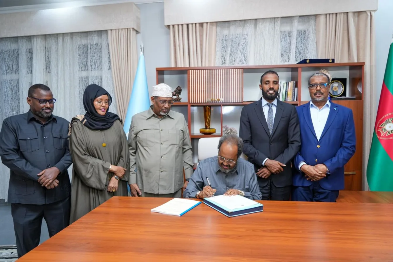
MOGADISHU — Somali President Hassan Sheikh Mohamud said Thursday that the completion of Somalia’s constitutional reform marks a historic step toward ending decades of political instability, insisting the changes are not intended to consolidate power under his leadership.
Speaking in Mogadishu, Mohamud described the adoption of a new constitutional framework as a “rebirth” for the Horn of Africa nation, saying it formally closes the long transitional period that began after the collapse of the Somali central government in 1991.
“This is a historic day,” Mohamud said. “We have officially concluded the long and difficult transitional era.”
Somalia has been governed under a provisional constitution since 2012, when the country began rebuilding national institutions after more than two decades of civil conflict and fragmented governance. The president said the completion of constitutional reforms establishes what he called a permanent legal framework intended to stabilize political institutions and strengthen state authority.
Mohamud argued that the prolonged transitional status had become a major obstacle to progress, limiting effective governance and contributing to political disputes between federal authorities and regional administrations.
“The transition had turned into a legal constraint that prevented the country from achieving full stability — politically, economically, socially and even in international relations,” he said.
Somalia has struggled to build stable governance structures since the collapse of the regime of Siad Barre in 1991, which plunged the country into civil war and years of statelessness. Various transitional charters and political arrangements have guided the rebuilding of national institutions over the past three decades.
According to Mohamud, previous attempts to finalize the constitution stalled because the remaining provisions dealt directly with sensitive political issues such as power-sharing between the federal government and regional states, management of natural resources, judicial authority and the country’s electoral system.
“The sections that remained unfinished were those that touched power itself,” the president said. “Whenever the final decision approached, political calculations, mistrust and delays would appear.”
He said the new constitutional arrangements aim to resolve those long-standing disputes and provide a clearer structure for governance.
The reforms, however, have generated debate among Somali political actors, with some critics expressing concern that constitutional changes could reshape the country’s political balance of power.
Mohamud rejected such claims, saying the reforms are intended to strengthen democratic institutions rather than benefit any individual leader.
“This constitution is not about extending anyone’s rule,” he said. “It is about giving Somalia a stable foundation for governance and development.”
Somalia continues to face major challenges including insecurity, political divisions among federal member states and the ongoing insurgency by the extremist group Al‑Shabaab.
Despite those challenges, Mohamud said the completion of the constitutional process represents a critical milestone in the country’s efforts to rebuild a functioning state after decades of conflict.