By HAN News Desk
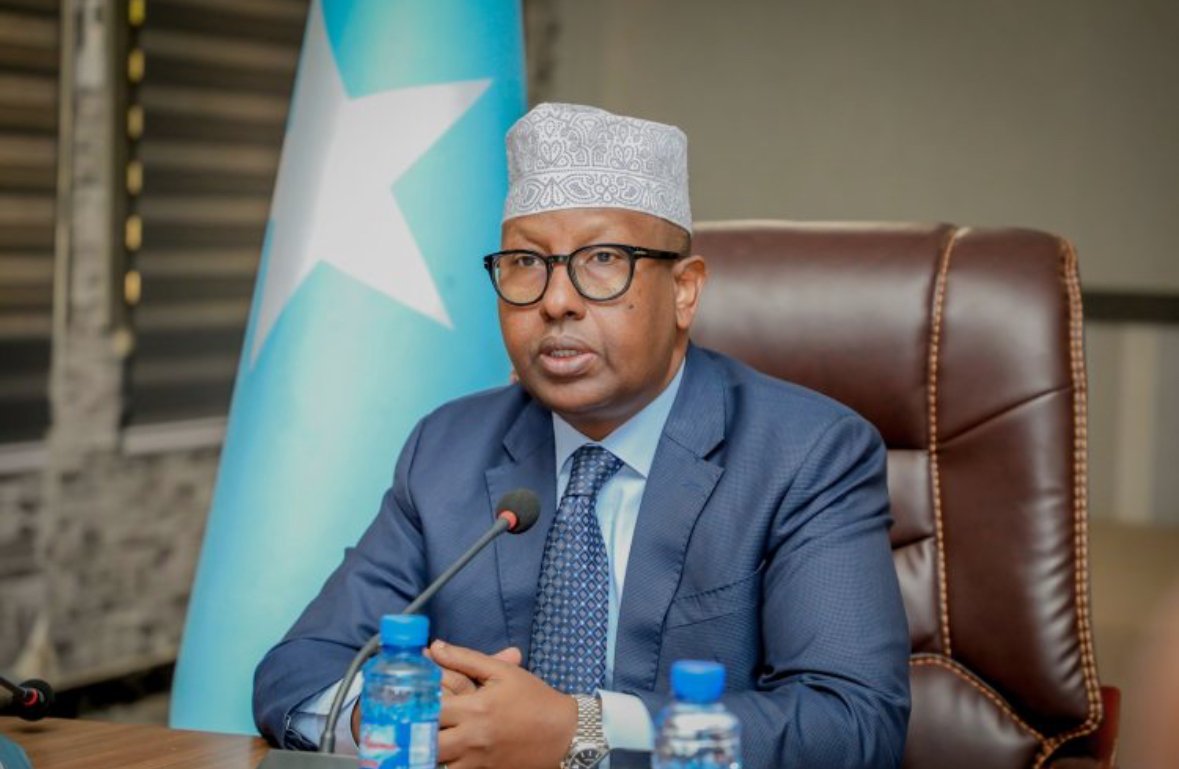
MOGADISHU — Somalia’s Federal Minister of Defence, Ahmed Moalim Fiqi, has issued a robust defence of the country’s newly implemented electronic visa system (eVisa), insisting that the digital platform is now a central pillar in Somalia’s national security architecture. Addressing journalists in Mogadishu during a briefing focused on migration, border control, and counterterrorism, Minister Fiqi said the transition from traditional visa processing to an online system has given the federal government a clearer, faster, and more reliable mechanism for screening travellers.
The minister revealed that the system has already helped national security agencies identify and prevent individuals linked to extremist groups—particularly the Islamic State (IS)—from entering Somalia. He noted that, before the introduction of the system, militant operatives often exploited the fragmented nature of immigration records, enabling them to cross airports or overland borders without rigorous checks. Fiqi said that since the launch of eVisa, authorities have not recorded a single IS member attempting to enter through Puntland or Somaliland, describing this as evidence of the system’s effectiveness.
Minister Fiqi rejected claims that the eVisa platform burdens ordinary citizens or travellers, arguing that, instead, it modernises procedures and aligns Somalia with global immigration standards. He emphasised that the system is designed to be user-friendly and eliminates unnecessary queues at airports by allowing applications to be submitted and processed online. According to him, no citizen is harmed by the system, and it strengthens transparency and state oversight.
He also addressed the constitutional basis for the federal government’s control over immigration, noting that the issue is clearly outlined in the current constitution, drafted during the tenure of former Puntland President Abdirahman Faroole. Fiqi said the law gives immigration authority to the Federal Government of Somalia and that this should not be a matter of political dispute.
Despite this, Puntland and Somaliland continue to oppose the eVisa rollout. Both administrations argue that Mogadishu should not have unilateral control over immigration or airspace management. Puntland officials accuse the federal government of bypassing power-sharing principles, while Somaliland authorities have expressed deep mistrust in the federal government’s handling of national airspace and passenger data. They argue that the system infringes on their autonomy and accuse Mogadishu of using immigration policy to exert political pressure.
Minister Fiqi, however, insisted that security concerns must override political disagreements, especially as Somalia continues to face threats from IS and Al-Shabaab. He said that a unified immigration system is essential for protecting the country, enhancing regional stability, and cooperating with international partners. Federal officials say the eVisa system also strengthens Somalia’s ability to share information with foreign governments and security agencies. Plans are underway to introduce biometric verification at major entry points, improve data-sharing with Interpol and African security networks, and establish a real-time watchlist for high-risk individuals.
As Somalia rebuilds state institutions after decades of conflict, the eVisa system has become a focal point in the broader debate over federalism and national security. For the government in Mogadishu, the system is here to stay, and officials argue that it is already proving effective in tightening the country’s borders and preventing extremist infiltration.