By HAN News Desk
MADRID — Spain’s prime minister pushed back forcefully against U.S. pressure Tuesday after former U.S. President Donald Trump threatened to end trade with Spain over its refusal to allow American warplanes to use Spanish military bases for a potential strike on Iran.
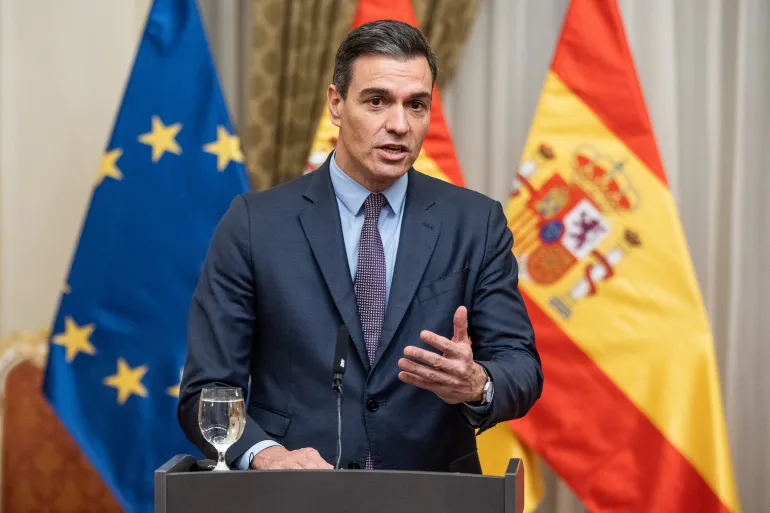
Prime Minister Pedro Sánchez addressed the nation in a televised speech, defending Spain’s decision to deny the United States access to the Rota Naval Base in Cádiz and Morón Air Base near Seville, two facilities frequently used by U.S. forces under long-standing bilateral defense agreements.
Sánchez said Spain would not support military action that could escalate tensions in the Middle East, emphasizing that Madrid favors diplomacy and international law over armed confrontation.
“Our position is clear,” Sánchez said during the 10-minute address broadcast nationwide. “Spain stands for peace, stability and international cooperation. The answer to another war is simple: No to war.”
The dispute intensified after Donald Trump criticized Spain during a campaign event and on social media, calling the country a “terrible partner” for refusing to support U.S. military operations. Trump warned that if he returned to power, he would consider cutting off trade relations with Spain, a move that could affect billions of dollars in goods exchanged annually between the two countries.
Spain is a member of North Atlantic Treaty Organization and hosts thousands of U.S. military personnel at its bases. The installations at Rota and Morón play a key role in U.S. military logistics and operations in Europe, Africa and the Middle East.
In his speech, Sánchez drew a historical comparison to the 2003 Iraq war, warning against repeating what he described as past mistakes. “Twenty-three years ago, another U.S. administration persuaded its allies to invade Iraq over weapons of mass destruction that were never found,” he said. “That war left deep scars — terrorism, instability, migration crises and economic consequences felt across Europe.”
He referenced the alliance between George W. Bush, Tony Blair and José María Aznar, which supported the invasion of Iraq in 2003. Sánchez described the partnership as the “Azores Trio,” referring to the summit in the Portuguese islands where the leaders announced their plan for military action.
“That decision did not bring peace or security,” Sánchez said. “For many Europeans it meant years of instability and hardship.”
Sánchez stressed that Spain remains a committed NATO ally but insisted that the country has the sovereign right to decide how its territory is used in military operations. “Our friendship with the United States is strong and enduring,” he said. “But alliances are built on mutual respect, not threats.”
Spanish officials say the government will continue to support diplomatic efforts aimed at reducing tensions with Iran and preventing a broader regional conflict. The issue has sparked debate inside Spain and across Europe, with some opposition politicians criticizing the government for risking relations with Washington while others praised the stance as a defense of peace and national sovereignty.
“Spain will always stand with its allies,” Sánchez said. “But we will not support another war whose consequences the world already knows too well.”