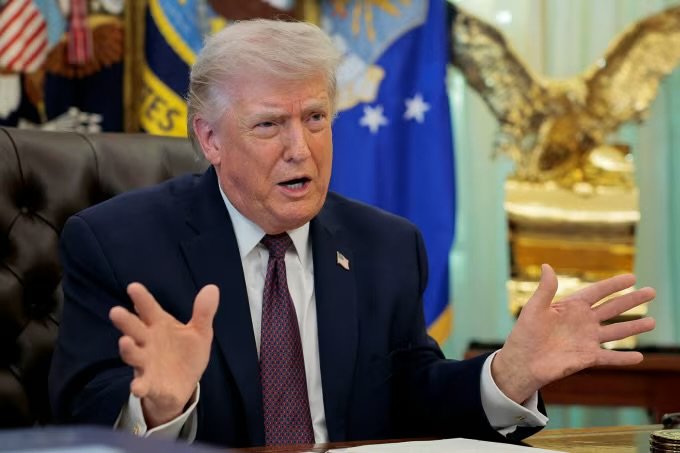
WASHINGTON — U.S. President Donald Trump has acknowledged the economic impact of the ongoing Middle East conflict involving Iran, suggesting that the situation can only be resolved by ending hostilities, while emphasizing that national security remains a top priority.
Speaking during a press exchange, Trump was confronted with concerns about rising fuel prices in the United States. A reporter noted that gasoline prices had climbed to $4 per gallon, reflecting growing pressure on American households.
Trump did not dispute the increase but shifted the focus to security concerns. “That’s true,” he said, referring to the price hike. “But nobody is going to drop a nuclear weapon on us.”
When pressed further about the economic strain on Americans, Trump argued that the public is also benefiting from increased safety. “They are also feeling safer,” he added, suggesting that current policies are aimed at preventing larger threats.
However, when asked directly about his plan to reduce energy costs, Trump indicated that de-escalation with Iran would be key. “What I’m doing is getting out of Iran so everything can return to normal,” he said, implying that reduced tensions could stabilize global energy markets.
According to analysts at the U.S. Energy Information Administration, geopolitical tensions in the Middle East often lead to immediate increases in global oil prices due to fears of supply disruptions, particularly around key shipping routes such as the Strait of Hormuz.
Experts from the Council on Foreign Relations note that any escalation involving Iran can significantly affect global energy markets, as Iran remains a major oil producer despite sanctions. They add that diplomatic de-escalation could help stabilize prices but may require complex negotiations.
Meanwhile, reporting by Reuters and BBC News has highlighted similar concerns, pointing out that rising fuel costs have become a political issue in the United States, influencing public opinion and policy debates.
The remarks highlight a broader debate in U.S. policy between maintaining a strong security posture and addressing domestic economic concerns. Trump’s comments suggest a potential shift toward disengagement as a means of easing both security risks and economic pressures, though details of how such a policy would be implemented remain unclear.