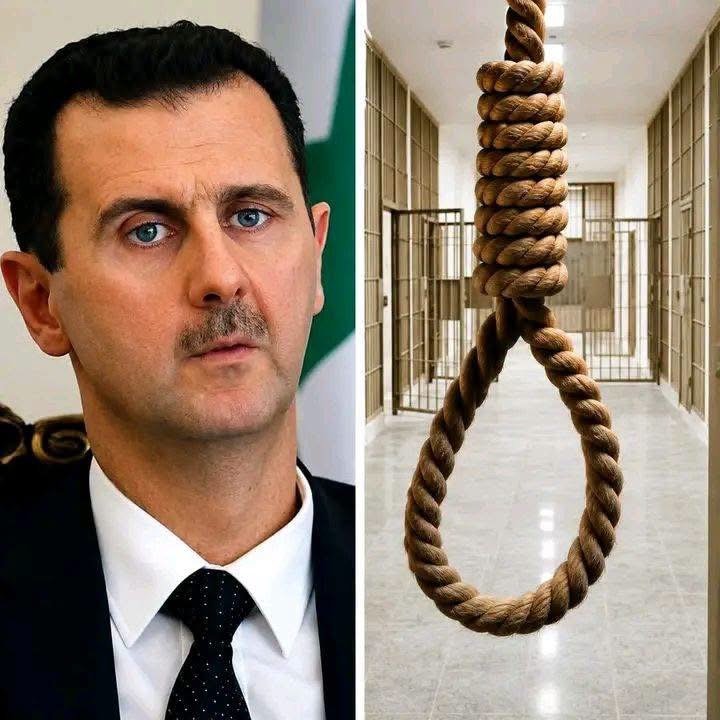
DAMASCUS — A Syrian court has sentenced former President Bashar al-Assad to death in absentia over serious crimes allegedly committed during his rule, in a landmark case that marks a major development in efforts to hold senior figures of the former regime accountable.
The ruling comes nearly two years after Assad was ousted from power in December 2024 following a rapid advance by opposition forces that culminated in the fall of Damascus and the collapse of his government.
The Fourth Criminal Court in Damascus found Assad responsible for a range of serious offences, including premeditated killings, torture, arbitrary detention and other abuses committed against civilians during the conflict.
Assad ruled Syria for nearly 25 years, succeeding his father, Hafez al-Assad, in 2000. His presidency was dominated by the uprising that began in 2011 and developed into a devastating civil war involving government forces, opposition groups, extremist organisations and foreign powers.
Assad fled to Russia
Following the fall of Damascus, Assad left Syria and travelled to Russia, where he and members of his family were granted asylum. He has remained outside Syria since his departure.
Because Assad is no longer in Syrian custody, the death sentence was issued in absentia and cannot immediately be carried out.
Syrian authorities have sought accountability for former regime officials and have previously called for Assad to face justice over alleged crimes committed during the war. His continued presence in Russia, however, presents a major obstacle to any attempt to enforce the sentence.
Other former regime officials sentenced
The court also handed down death sentences against Assad’s cousin, Atef Najib, and several other senior officials from the former government.
Najib, the former head of political security in Daraa, was reportedly the only one of the defendants present in court. He has been accused of playing a central role in the security crackdown on protesters in Daraa in 2011.
The crackdown was among the early events of the uprising against Assad’s government and became a turning point that contributed to the escalation of protests into a nationwide armed conflict.
The court proceedings are part of broader efforts by Syria’s post-Assad authorities to investigate alleged abuses committed by the former government and bring senior officials before the courts.
Years of war and abuses
Syria’s conflict began in March 2011 after demonstrations demanding political reform and greater freedoms were met with a violent government crackdown.
The fighting eventually drew in dozens of armed groups and foreign powers, including Russia and Iran, which supported Assad’s government, as well as a US-led coalition that fought Islamic State militants.
Over more than a decade of conflict, hundreds of thousands of people were killed, while millions were forced to flee their homes. Large parts of Syria’s infrastructure were destroyed, and the country experienced widespread economic collapse and humanitarian suffering.
International investigators, human rights organisations and United Nations bodies have documented allegations of widespread killings, torture, enforced disappearances, arbitrary detention and attacks on civilian areas during the conflict.
Rights groups have repeatedly called for those responsible for serious violations to be investigated and prosecuted.
A significant moment for victims
The death sentence against Assad is likely to have major symbolic importance for Syrians who lost relatives, were imprisoned or tortured, or were forced to flee their homes during the conflict.
Families of people who disappeared during Assad’s rule have long demanded information about the fate of their relatives and accountability for those responsible.
The United Nations Independent International Commission of Inquiry on Syria has welcomed efforts to pursue accountability while stressing the importance of fair trials and respect for the rights of victims, survivors and defendants.
The case also presents a major test for Syria’s new authorities as they attempt to establish a system of transitional justice following decades of authoritarian rule.
For many victims, however, the court ruling represents only the beginning of a much broader process. They are seeking not only punishment for senior officials but also the recovery of missing persons, documentation of abuses, compensation for victims and guarantees that similar violations will not be repeated.
With Assad still living in Russia, the practical enforcement of the death sentence remains uncertain. Nevertheless, the ruling could become one of the most consequential legal actions taken against a former Syrian leader since the country entered its post-Assad political era.