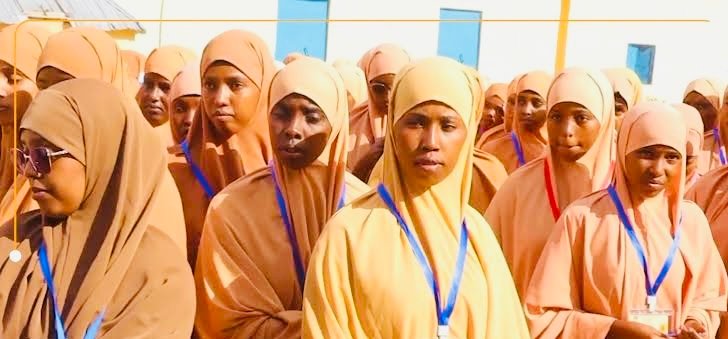
MOGADISHU: A total of 43,028 students from Banadir Region and Somalia’s federal member states, excluding Puntland and Somaliland, sat for the Grade 12 national secondary school examination for the 2025/2026 academic year.
The examination was administered simultaneously at 158 examination centres across 58 districts throughout the country.
The 2025/2026 examination marked the 12th consecutive national examination administered by Somalia’s Ministry of Education, Culture and Higher Education and recorded the largest number of candidates since the national examination system was reintroduced.
Beyond the figures, however, the history of Somalia’s national examination reflects a much broader transformation in the country’s education system—from fear and uncertainty to greater public acceptance, stronger institutional control and increased confidence in a unified national assessment system.
Three Major Phases of Somalia’s National Examination
The development of the national Grade 12 examination can broadly be divided into three phases: the era of fear and uncertainty, the era of awareness and controversy, and the current era of consolidation and progress.
1. The Era of Fear and Uncertainty
After a gap of approximately 24 years, Somalia’s Ministry of Education, Culture and Higher Education resumed the administration of a national examination in 2015.
The return of the national examination took place under extremely difficult security and institutional circumstances.
Many students sat the examination without the standard school uniforms normally associated with formal education. Security concerns surrounding examination centres were significant, with emergency vehicles and ambulances stationed at some locations as a precaution.
For students who had already experienced years of instability, the presence of emergency and security arrangements around examination centres contributed to an atmosphere of anxiety and uncertainty.
The challenges were not limited to security.
Students were coming from schools operating with different curricula, teaching standards and educational backgrounds, making the introduction of a unified national examination particularly difficult.
As a result, many students did not sit the national examination during its early years. Some were unable to participate because of insecurity and difficult circumstances, while others did not yet understand the importance of a national examination or lacked confidence in the newly reintroduced system.
Over time, however, the government began to recognize some of the exceptional circumstances surrounding the early examinations. In some cases, students who had been unable to participate were later given opportunities to sit examinations after their circumstances were reviewed.
The first phase was therefore characterized by fear, uncertainty, limited participation and a lack of public familiarity with the national examination system.
2. The Era of Awareness and Controversy
The second phase began as Somali society increasingly recognized the importance of the national examination.
Although concerns about examinations and security had not completely disappeared, they were gradually overshadowed by a growing understanding that examination results could have a significant impact on students’ academic and professional futures.
As the importance of obtaining high marks increased, competition among students and schools also intensified.
This period was unfortunately accompanied by serious controversies surrounding the integrity of the examination system.
At one point, individuals within different levels of the education sector were accused of contributing to attempts to compromise the national examination process.
Former Education Minister Abdullahi Goodax Barre publicly addressed the issue at the time, and the government eventually took the decision to cancel an examination that was already underway after serious concerns were raised about its integrity.
The controversy demonstrated the enormous challenge facing Somalia: establishing a national examination system was not simply a matter of printing examination papers and distributing them. It also required the creation of a culture of academic integrity, confidentiality, fairness and accountability.
Growing Debate Over Regional Performance
Another major issue that emerged during this period was the perceived difference in examination performance between students in Banadir Region and those in other parts of the country.
Students from some federal member states were increasingly achieving higher grades, leading to public debate over whether students outside Mogadishu had better opportunities to perform well in the national examination.
Some government officials attributed the comparatively weaker performance of some students in Banadir to social factors, including substance use and excessive use of social media platforms, particularly TikTok.
Whether or not such explanations fully account for differences in performance, the debate itself highlighted the growing importance attached to examination results.
The competition became so significant that some students and families in Mogadishu reportedly began considering opportunities to study or sit examinations in other regions, hoping that this would improve their chances of obtaining higher grades.
The second phase therefore became a period of greater awareness, intense competition, controversy and institutional learning.
3. The Era of Consolidation and Progress
The third phase represents the current period and is arguably the most advanced stage in the development of Somalia’s national examination system.
One of the most significant changes has been the gradual disappearance of the fear and insecurity that characterized the earliest examinations.
The national examination has become increasingly institutionalized, with examination centres established in additional locations across southern, central and northern Somalia.
The Ministry of Education has also strengthened its control over the examination process.
According to the information provided, Ministry personnel are increasingly responsible for key stages of the examination cycle, including:
- Examination preparation and setting
- Printing
- Transportation and distribution
- Security and supervision
- Collection of examination materials
- Marking and assessment
Bringing these responsibilities under greater institutional control is intended to reduce the possibility of examination papers or other sensitive information being leaked before or during the examination.
This represents a major shift from the early years, when institutional capacity and security challenges made the examination process significantly more vulnerable.
A Decade of Growth in Candidate Numbers
The statistics demonstrate how dramatically participation in Somalia’s national examination has expanded over the past decade.
From 11,574 candidates in 2016, participation rose to more than 38,000 candidates in 2025, while the 2025/2026 academic year saw 43,028 students sit the examination—the highest number recorded since the system was reintroduced.
| Year | Candidates | Passed | Failed/Did Not Pass | Top-Ranked Region | Gender of Top Candidate |
| 2016 | 11,574 | 19,104* | 1,470 | Banadir | Female |
| 2017 | 18,239 | 15,356 | 2,883 | Banadir | Male |
| 2018 | 25,675 | 20,030 | 5,645 | Banadir | Male |
| 2019 | 29,434 | 22,499 | 6,935 | Banadir | Male |
| 2020 | 33,727 | 25,177 | 8,550 | Banadir | Male |
| 2021 | 34,908 | 30,262 | 4,646 | Galmudug | Male |
| 2022 | 33,468 | 32,325 | 1,143 | Banadir | Male |
| 2023 | 32,501 | 30,005 | 2,496 | Jubaland | Female |
| 2024 | 36,034 | 33,668 | 2,366 | Banadir | Male |
| 2025 | 38,471 | 32,714 | 5,757 |
The 2016 figures in the supplied data appear internally inconsistent because the number listed as having passed is higher than the number of candidates. The official figures should therefore be verified before publication.
The broader trend, however, is clear: participation in the national examination has increased substantially over the past decade.
This growth reflects the expansion of secondary education, increased public acceptance of the national examination and the gradual strengthening of Somalia’s education institutions.
From a Security Challenge to a National Institution
The transformation of Somalia’s national examination cannot be measured only by the number of students taking the test.
Its significance lies in the fact that an examination system that was once conducted under considerable fear and uncertainty has gradually evolved into a nationwide institutional process.
The examination now provides a common assessment framework for students from different regions and educational backgrounds.
This is particularly important in a country where schools have historically operated under different curricula, varying levels of resources and different administrative structures.
A national examination can therefore serve as an important mechanism for establishing a common educational standard.
It also provides the government with valuable information about student performance and can help identify areas where schools, teachers and education authorities require additional support.
The Importance of Examination Integrity
One of the most important lessons from the history of Somalia’s national examination is that public confidence depends on integrity.
An examination is only meaningful when students, parents, teachers, universities and the wider public believe that the results are fair and accurately reflect students’ performance.
The controversies that affected earlier examinations demonstrated how quickly public confidence can be damaged when examination security is compromised.
The Ministry’s efforts to strengthen control over the examination process—from preparation and printing to transportation, supervision and marking—are therefore central to protecting the credibility of the system.
Maintaining strict confidentiality and professional standards throughout the process will remain essential as the number of candidates continues to increase.
A National Standard for Somali Education
The national Grade 12 examination has also taken on a broader role in Somalia’s education system.
It is no longer simply an examination taken by graduating students. It has become part of a national effort to create common standards for assessing educational achievement.
For students, the examination represents an important transition point between secondary education and higher education or employment.
For universities and other institutions, examination results provide one of the indicators used to assess students’ academic preparedness.
For the government, the results can provide a broader picture of the performance of Somalia’s education system.
Conclusion
The history of Somalia’s Grade 12 national examination can be understood through three broad stages: fear and uncertainty, awareness and controversy, and consolidation and progress.
When the national examination was reintroduced after decades of interruption, it faced serious security, institutional and educational challenges. Over time, however, the system gradually gained public recognition and became an increasingly important part of Somalia’s national education framework.
The rise in the number of candidates—from thousands in the early years to 43,028 students in 2025/2026—demonstrates the scale of this transformation.
Yet the success of the national examination should not be measured by participation numbers alone.
Its long-term credibility will depend on fairness, transparency, examination security, professional administration and equal treatment of students regardless of where they live.
If the progress achieved in recent years is maintained and further strengthened, Somalia’s national examination could become a trusted national benchmark for measuring educational quality, student achievement and the academic preparedness of the country’s next generation.
More importantly, a credible national examination system can contribute to rebuilding confidence in Somalia’s education sector and strengthening a common national standard for learning across the country.