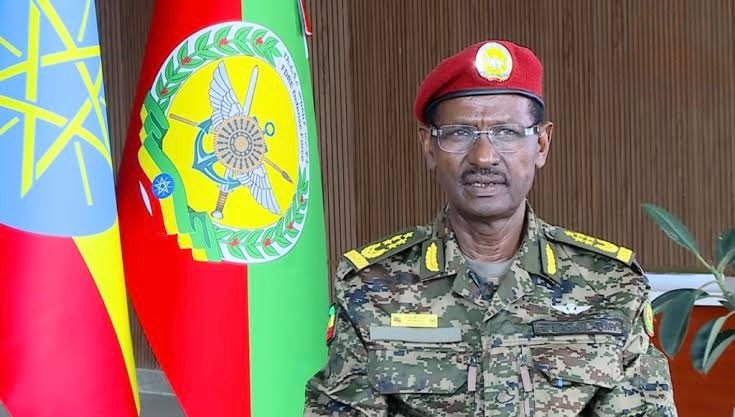
ADDIS ABABA — Ethiopia’s military chief has accused Eritrea of providing financial and other support to armed groups seeking to weaken the Ethiopian government, as renewed fighting in the country’s north raises fears of a wider conflict.
Field Marshal Berhanu Jula, Chief of Staff of the Ethiopian National Defence Force, said the military was responding with what he described as “wisdom and restraint” to what he called provocations and attacks originating from the Tigray front.
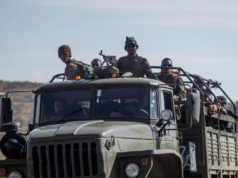
His remarks came as fighting between federal forces and Tigrayan fighters intensified in several areas of northern Ethiopia, including parts of Tigray, Afar and Amhara regions.
Berhanu accused Eritrea of supporting armed groups operating against the Ethiopian government and linked the developments to what he described as longstanding hostile alliances. The accusations have not been independently verified.
Eritrea has rejected allegations that it is supporting armed groups inside Ethiopia. As tensions between the two countries have increased, Eritrea has also expressed concern over Ethiopia’s efforts to secure access to the Red Sea. Addis Ababa has repeatedly emphasized the importance of obtaining reliable access to the sea for its landlocked economy.
Fighting spreads beyond Tigray
The latest clashes have extended beyond Tigray into neighbouring Afar and Amhara, increasing concerns that the confrontation could develop into a broader conflict involving armed groups from several parts of Ethiopia.
Seven armed groups recently announced the formation of the Ethiopian Peoples’ Forces Alliance for Survival, saying they wanted to remove Prime Minister Abiy Ahmed’s government from power. The coalition includes groups from different regions and political backgrounds, including the Tigray People’s Liberation Front (TPLF) and the Amhara Fano National Movement.
The formation of the alliance represents a significant shift in Ethiopia’s political and military landscape, bringing together groups that have previously been on opposing sides of the country’s conflicts. The groups have said they share opposition to the federal government, although differences remain among them over political and territorial issues.
The Ethiopian government has accused the alliance of receiving support from Eritrea, while Eritrea has denied the allegations.
Clashes in Afar and Amhara
In Afar, fighting has been reported around Abala and other areas near the Tigray border. Reports indicate that Tigrayan forces and allied fighters have been involved in clashes with federal forces in the region.
The conflict has also reached North Wollo in Amhara Region, which borders Tigray. Ethiopia’s military said it launched a counteroffensive after Tigrayan fighters attacked positions in the area.
The Ethiopian National Defence Force said on Thursday that 272 Tigrayan fighters were killed and 260 wounded during the fighting. The military also said several fighters were captured. The figures have not been independently verified.
There have also been reports of fighting around areas including Sama, Sokota and Raya Alamata, adding to concerns that the violence could spread further into northern Ethiopia.
TPLF describes situation as full-scale war
The TPLF has accused the federal government of launching what it described as a major offensive involving ground troops, military vehicles and drones.
Abdisalam Balema, a member of the TPLF central committee, told Al Jazeera that the situation had developed into what he described as a “full-blown war.” The TPLF and federal authorities have issued conflicting accounts of who initiated the latest escalation.
The renewed fighting comes after months of political and military tensions between the federal government and Tigray’s leadership. Both sides have accused the other of violating commitments made under the 2022 peace agreement.
Pretoria peace agreement under pressure
The Pretoria Agreement, signed in November 2022, ended two years of devastating war between the Ethiopian federal government and the TPLF. The agreement established a permanent cessation of hostilities and included provisions concerning the disarmament and reintegration of Tigrayan forces, restoration of federal institutions, political dialogue and the return of displaced people.
However, several major political, territorial and security disputes remained unresolved after the agreement. Those unresolved issues, combined with divisions within Tigray and worsening relations between Ethiopia and Eritrea, have contributed to renewed tensions.
The African Union has warned that the latest escalation threatens the progress made under the Pretoria agreement. The AU has called for restraint, an immediate reduction in hostilities and a return to direct talks within the framework of the 2022 agreement.
The renewed fighting has also included reports of drone strikes and military movements in northern Ethiopia. Civilian air services have been disrupted after Tigrayan forces seized or occupied airports in Mekelle, Axum and Shire, according to the African Union.
Rising concerns over regional involvement
The renewed confrontation is particularly sensitive because Eritrean forces fought alongside Ethiopian government troops during the 2020–2022 Tigray war. Eritrea was not a party to the Pretoria peace agreement, and relations between Asmara and Addis Ababa have deteriorated since the agreement was signed.
The dispute has also become closely linked to Ethiopia’s search for access to the Red Sea. Eritrea has expressed concern over Ethiopia’s ambitions for maritime access, while Ethiopian officials have repeatedly described access to the sea as an important national interest.
Analysts have warned that continued fighting could connect several existing conflicts in Ethiopia and potentially draw neighbouring countries into the crisis. However, the extent of any external military or financial involvement remains disputed.
For now, Ethiopia’s military leadership says it intends to respond to the escalating situation while avoiding a broader war. At the same time, the TPLF and other armed groups are maintaining their opposition to the federal government, leaving the 2022 peace agreement under significant pressure.
The African Union and other international actors have called for de-escalation and renewed dialogue as fighting continues across parts of northern Ethiopia.