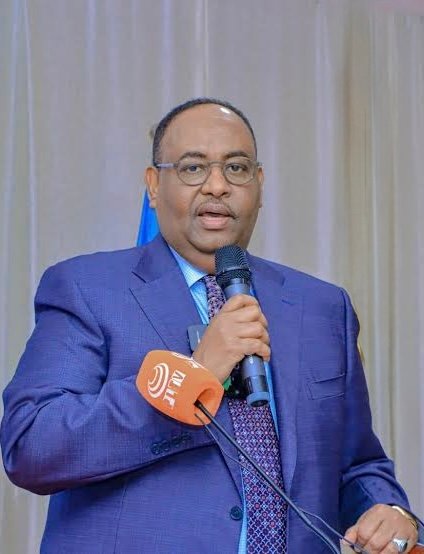
GAROWE, PUNTLAND – Puntland President Said Abdullahi Deni has strongly criticized Somali President Hassan Sheikh Mohamud, accusing him of abandoning consensus-based elections and pursuing unilateral political decisions that could threaten Somalia’s national unity, constitutional order and federal governance system.
Speaking on Sunday at the opening of the 59th session of the Puntland Parliament in Garowe, Deni warned that the Federal Government’s recently announced electoral timetable could deepen political divisions and undermine years of efforts to establish a stable and functioning Somali state.
The Puntland leader accused President Hassan Sheikh Mohamud of disregarding the political agreements that formed the foundation of Somalia’s federal governance system, including the 2012 Provisional Constitution.
Deni argued that these agreements were essential to Somalia’s post-transition political settlement and that any changes to the electoral framework should be negotiated among the Federal Government, federal member states and other relevant political stakeholders.
Deni Rejects Federal Government’s Electoral Timetable
Deni specifically criticized the electoral timetable announced on October 15, accusing President Hassan Sheikh Mohamud of proceeding with national elections without securing broad political consensus.
Under the announced schedule, elections for both houses of Somalia’s Federal Parliament are expected to take place on April 15, 2027, followed by a presidential election on May 15, 2027.
The timetable, announced by Somalia’s National Independent Electoral and Boundaries Commission, has intensified disagreements between the Federal Government and political leaders who question the legitimacy of constitutional and electoral changes adopted without wider consultation.
Deni warned that implementing the electoral process without an inclusive political agreement could damage Somalia’s state-building efforts and further weaken relations between Mogadishu and regional administrations.
He emphasized that Somalia’s political future should be determined through dialogue, constitutional principles and agreements reflecting the interests of the country’s different communities and political institutions.
Puntland Calls for Urgent National Political Dialogue
The Puntland president called on Somali political leaders, traditional elders, intellectuals, civil society representatives and other segments of society to participate in urgent consultations aimed at resolving the growing political dispute.
He urged national stakeholders to prioritize dialogue and compromise to protect Somalia’s unity and preserve the federal system.
Deni also appealed to international partners supporting Somalia’s governance and state-building process to encourage inclusive political negotiations.
According to the Puntland leader, sustainable political arrangements cannot be achieved through unilateral decisions but require broad agreement among the country’s principal political stakeholders.
Deni Acknowledges Frustration Among Puntland Residents
During his address to lawmakers, Deni acknowledged growing frustration among Puntland residents over Somalia’s political direction and the continued disagreements surrounding the country’s governance arrangements.
He said many Puntland citizens had long hoped to see the emergence of a peaceful, stable and fully functioning Somali state based on constitutional governance, cooperation and respect for the federal system.
The Puntland president pledged that his administration would not take decisions that undermined the interests, rights or aspirations of the people of Puntland.
He also indicated that his government would consult residents, political representatives and other stakeholders before determining its next steps in response to the ongoing national political dispute.
His remarks suggested that Puntland intends to maintain its opposition to the disputed electoral arrangements while considering further political measures through consultation.
Puntland, Jubaland and Opposition Groups Challenge Electoral Framework
The latest disagreement comes amid continuing tensions between the Federal Government and the administrations of Puntland and Jubaland, alongside several Somali opposition groups.
These political actors have challenged the Federal Government’s constitutional amendments and electoral arrangements, arguing that major changes to Somalia’s governance system should not proceed without a comprehensive national agreement.
They maintain that the country’s federal structure was established through political negotiations and that altering its constitutional foundations without sufficient consultation risks undermining trust among federal institutions.
The opposition has also raised concerns about the management of elections, political representation and the balance of authority between the Federal Government and federal member states.
Federal Government Defends Electoral Reforms
The Federal Government, however, maintains that its electoral timetable is consistent with Somalia’s revised constitutional framework and applicable electoral legislation.
Federal authorities have advocated reforms intended to move Somalia toward direct elections, reduce reliance on indirect political selection processes and strengthen public participation in democratic governance.
Supporters of the reforms argue that establishing a clearer electoral framework is necessary for strengthening national institutions and advancing Somalia’s democratic transition.
Nevertheless, disagreements remain over the constitutional legitimacy of the reforms, their implementation and the extent of political consultation required before nationwide elections can proceed.
Somalia’s Federal System Faces a Political Test
Somalia’s federal system emerged from years of political negotiations following prolonged conflict and institutional collapse.
The 2012 Provisional Constitution established the framework for rebuilding federal institutions and defining relations between the central government and federal member states.
However, disagreements over constitutional authority, resource sharing, regional autonomy and electoral procedures have continued to challenge cooperation between Mogadishu and some regional administrations.
The current electoral dispute has brought these unresolved questions back to the forefront of national politics.
Political observers have expressed concern that prolonged disagreements could complicate election preparations, weaken institutional cooperation and divert attention from other national priorities, including security, economic recovery and humanitarian challenges.
Growing Pressure for a Negotiated Settlement
Deni’s latest remarks underscore the widening differences between the Puntland administration and President Hassan Sheikh Mohamud’s government over the direction of Somalia’s constitutional and electoral reforms.
With parliamentary and presidential elections scheduled for 2027 under the announced timetable, the central issue remains whether the Federal Government and its political opponents can reach an agreement on the electoral process.
The dispute also raises broader questions about the future of federalism, the role of regional administrations and the mechanisms through which Somalia’s political leadership should be selected.
For Puntland, the immediate priority, according to Deni, is securing a political settlement that respects the country’s federal arrangements and reflects the aspirations of Somali citizens.
For the Federal Government, implementing its electoral reform agenda remains a central component of its proposed democratic transition.
The coming months will be important in determining whether Somalia’s competing political stakeholders can resolve their disagreements through negotiations ahead of the proposed 2027 elections.