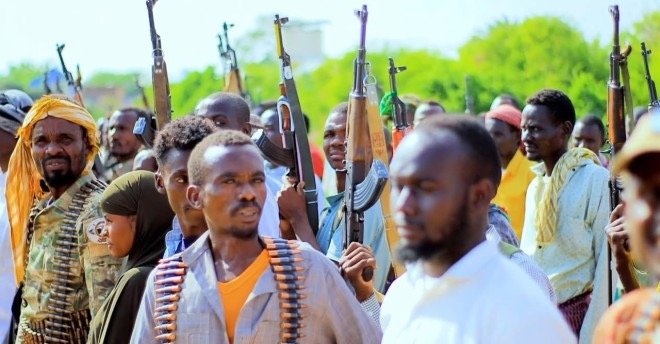
BELEDWEYNE — Armed Macawisley militia fighters from the Afar Makane clan staged a major show of force in Beledweyne on Saturday, publicly declaring their opposition to the Hirshabelle administration and expressing unwavering support for Hawadle traditional leader Ugaas Yusuf Ugaas Hassan.
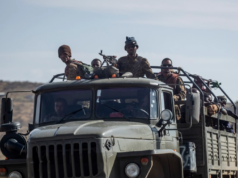
Dozens of armed fighters, including women carrying AK-47 rifles, assembled in the city in a demonstration intended to signal their political position and solidarity with Ugaas Yusuf amid escalating tensions over the political future of Hiiraan.
The gathering comes at a particularly sensitive time, as traditional elders, politicians, community representatives, and several clans in Hiiraan continue to challenge the legitimacy of Hirshabelle’s recent leadership selection process. Critics accuse the administration of marginalizing local communities and making important political decisions without meaningful consultation with the people of the region.
Camba Gooye: The Makane Community Stands Behind Ugaas Yusuf
Abdiwajid Sheikh Nuriyow, widely known as Camba Gooye, a former deputy governor of Hiiraan responsible for social affairs who recently resigned from his government position, declared that the Afar Makane community stood firmly behind Ugaas Yusuf and his political position.
Speaking during the gathering, Camba Gooye emphasized that the people of Hiiraan shared a common destiny, historical connections, and collective interests that could not be separated by political disagreements.
“Regarding Hiiraan and its cause, its unity and cohesion, we are driven by our shared lives and common heritage,” Camba Gooye said.
He further stated that the community had rejected the current Hirshabelle leadership and was prepared to respond to the calls and decisions of the traditional leader.
“Whatever harms the people of Hiiraan harms us as well. We are ready to act upon whatever the Ugaas has called for,” he added.
His remarks highlighted the growing political alignment between different community groups in Hiiraan around the leadership of Ugaas Yusuf.
Makane Politician Accuses Hirshabelle of Political Marginalization
Osman Adan Careys, a prominent politician from the Afar Makane clan, also criticized the Hirshabelle administration, accusing it of failing to provide genuine political representation for his community.
Careys argued that individuals currently occupying positions in the name of the Makane community had not received a legitimate mandate from their own people.
He insisted that political representation should come directly from the community rather than being imposed through political arrangements negotiated by regional authorities.
“Those who represent us must be chosen by the Makane people themselves; we have no genuine representation within Hirshabelle,” he said.
His comments reflect broader disagreements over the distribution of political power and administrative positions within Hirshabelle State.
Community Rejects Existing Power-Sharing Arrangements
In a separate statement, representatives of the Afar Makane community rejected the existing political and power-sharing arrangements in Hirshabelle, arguing that their clan had been denied adequate representation in government institutions and administrative structures.
The representatives said the community was reconsidering its political relationship with the Hirshabelle administration and reaffirmed its right to participate in determining its own political future.
They also indicated their willingness to cooperate with political movements and groups prepared to address their grievances and guarantee fair representation, equality, justice, and meaningful participation in regional governance.
Political Crisis Deepens Following Gudlawe’s Re-election
The mobilization in Beledweyne comes amid growing political opposition to Hirshabelle’s leadership following the October 24 re-election of President Ali Abdullahi Hussein Gudlawe and the election of Abdifatah Hassan Afrah as vice president in Jowhar.
The leadership selection has generated controversy, particularly among political figures and community groups in Hiiraan who question the inclusiveness and legitimacy of the process.
Critics argue that the political future of Hirshabelle cannot be determined without the genuine participation and consent of the communities that make up the regional administration.
The latest show of support from the Afar Makane community for Ugaas Yusuf represents another significant development in the unfolding political dispute.
A Growing Political Front in Hiiraan
The appearance of armed Macawisley fighters, alongside public declarations of political allegiance, demonstrates the seriousness of the growing tensions surrounding Hirshabelle’s leadership and the future of Hiiraan.
The development also highlights the increasing influence of traditional elders and community leaders in mobilizing political opposition and demanding a new approach to regional governance.
As more community representatives publicly express dissatisfaction with the current administration, pressure is mounting for meaningful political dialogue, inclusive representation, and a resolution that addresses the longstanding grievances of Hiiraan’s communities.
The central question facing Hirshabelle is increasingly whether its political leadership can restore confidence among the communities it governs or whether the growing opposition in Hiiraan will further deepen the region’s political divisions.