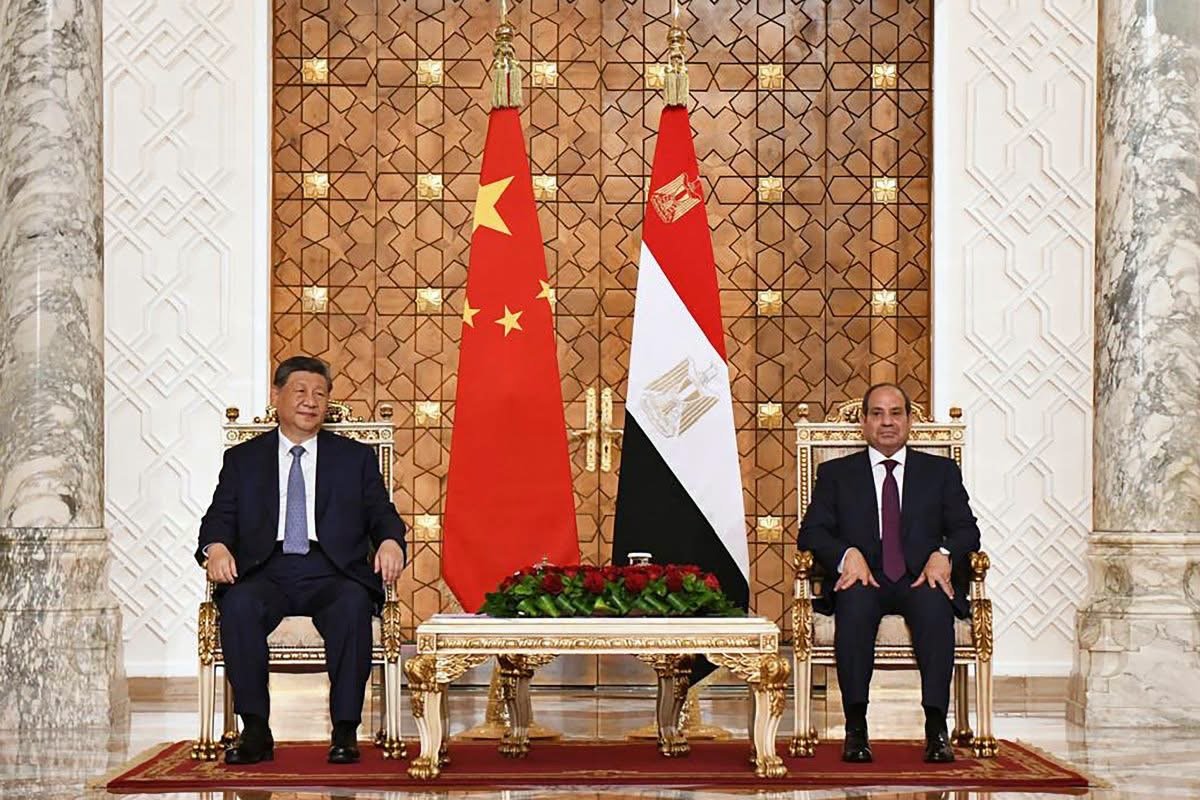
CAIRO — Chinese President Xi Jinping has called for a new regional security framework for the Middle East, urging countries across the region to strengthen dialogue, reject external interference and take greater responsibility for maintaining peace and stability.
Xi made the proposal during high-level talks with Egyptian President Abdel Fattah El-Sisi in Cairo during a rare visit to Egypt. The meeting comes as the Middle East faces renewed geopolitical tensions, growing security challenges and increasing competition among major international powers for strategic influence.
The Chinese leader’s visit highlights Beijing’s expanding diplomatic engagement in the Middle East and its growing interest in playing a larger role in regional security, economic development and international diplomacy.
Xi’s Four-Point Security Proposal
During his discussions with President Sisi, Xi outlined a four-point approach to regional security based on the principles of common, comprehensive, cooperative and sustainable security.
Xi argued that Middle Eastern countries should play the central role in determining their own security arrangements and political future. He emphasized that regional disputes should be addressed through dialogue, consultation and political negotiations rather than prolonged confrontation or external intervention.
The Chinese president also called for a comprehensive approach to regional security, stressing that the region’s conflicts and crises are interconnected and cannot be addressed effectively through isolated measures.
According to Xi’s approach, security should also be supported by economic development. He argued that lasting stability requires countries to improve living standards, strengthen economic opportunities and address the social and economic conditions that can contribute to instability.
China has also expressed its willingness to cooperate with Middle Eastern countries on maritime security and the protection of international shipping routes, particularly as disruptions in the region continue to raise concerns for global trade.
Palestinian Issue Remains Central
Xi emphasized that the Palestinian issue remains at the center of the broader Middle East crisis and should not be marginalized.
China has repeatedly called for a political solution to the Israeli-Palestinian conflict and has supported the establishment of a Palestinian state based on internationally recognized principles.
During his discussions in Cairo, Xi stressed the importance of stronger international coordination and reaffirmed the role of the United Nations Charter and international law in addressing regional disputes.
He also urged external powers to respect the sovereignty and territorial integrity of Middle Eastern countries and encouraged greater international support for diplomatic efforts aimed at reducing conflict.
China and Egypt Strengthen Strategic Relations
The talks between Xi and Sisi extended beyond regional security.
China and Egypt agreed to strengthen cooperation across a broad range of areas, including trade, investment, infrastructure, technology, energy, security, counterterrorism, education and industrial development.
More than 20 cooperation documents were signed or agreed upon, covering areas such as the digital economy, science and technology, education, transportation, artificial intelligence, trade and industrial supply chains.
The agreements reflect the expanding economic relationship between Beijing and Cairo and demonstrate China’s interest in Egypt as a major regional partner.
Egypt has also shown interest in expanding security and military cooperation with China while continuing to maintain its longstanding strategic relationship with the United States.
Why Egypt Matters to China
Egypt occupies a strategically important position linking Africa, the Middle East and the Mediterranean.
The country’s control of the Suez Canal gives it an especially important role in international commerce. The canal provides one of the world’s key maritime routes between Europe and Asia and remains critical to global supply chains.
China has invested significantly in Egypt, including infrastructure, manufacturing and industrial projects connected to the Suez Canal Economic Zone.
For Beijing, closer relations with Cairo therefore provide both economic and geopolitical advantages. Egypt can serve as an important gateway for Chinese trade and investment while also providing a diplomatic bridge between China and the wider Arab world.
Maritime Security and the Red Sea
The security of the Red Sea and surrounding waterways has become increasingly important for both China and Egypt.
The region connects the Mediterranean and Indian Ocean through the Suez Canal and the Red Sea, making it vital for international shipping and energy transportation.
China has a direct economic interest in maintaining freedom of navigation because Chinese companies depend heavily on international maritime trade.
Egypt, meanwhile, has a direct economic interest in the security of the Suez Canal, through which the country generates substantial revenue.
Any prolonged disruption to shipping in the Red Sea can therefore have consequences far beyond the region, affecting transportation costs, supply chains and global trade.
A Changing Regional Balance
Xi’s proposal comes as the Middle East undergoes significant geopolitical changes.
Growing tensions involving major regional and international powers have raised questions about the future of security arrangements in the region. Countries across the Middle East are increasingly seeking to diversify their international partnerships rather than relying exclusively on one major power.
China’s approach emphasizes diplomacy, economic cooperation and regional ownership of security issues.
Beijing has increasingly presented itself as a country capable of maintaining relationships with different sides of the Middle Eastern political landscape. Its economic influence has also expanded through infrastructure, energy, technology and trade partnerships.
China’s Expanding Diplomatic Role
Xi’s call for a new security framework represents more than a diplomatic statement. It demonstrates Beijing’s ambition to become a more influential participant in discussions concerning the future of the Middle East.
China has traditionally focused on economic engagement in the region, but its diplomatic involvement has expanded in recent years.
Beijing now seeks a greater role in political mediation, regional security discussions and international initiatives aimed at reducing tensions.
The Chinese government argues that sustainable peace cannot be achieved through military solutions alone and that regional countries should have a stronger voice in determining their own security arrangements.
Egypt’s Strategic Balancing
For Egypt, closer cooperation with China provides an opportunity to strengthen ties with another major global power while maintaining its established relationship with Washington.
Cairo has traditionally sought to balance relationships with major international powers based on its national interests, economic needs and regional security priorities.
China’s growing economic presence offers Egypt additional opportunities for investment, infrastructure development, technology cooperation and trade.
At the same time, Egypt remains an important partner for the United States in the Middle East and North Africa, meaning Cairo is likely to continue pursuing a carefully balanced foreign policy.
What Comes Next?
Xi’s visit to Egypt could mark an important stage in the evolution of China’s relationship with the Middle East.
The success of Beijing’s proposed security framework will depend largely on whether regional governments are willing to cooperate, reduce tensions and establish mechanisms for dialogue.
For Egypt, the priority remains protecting its national security, maintaining the stability of the Suez Canal and strengthening its economic partnerships.
For China, the Middle East represents an increasingly important economic and strategic region where stability is essential to global trade and China’s international interests.
Xi’s Cairo visit therefore carries significance beyond China-Egypt relations. It reflects a broader effort by Beijing to expand its diplomatic influence, promote regional dialogue and position China as an increasingly important player in the evolving security and political order of the Middle East.