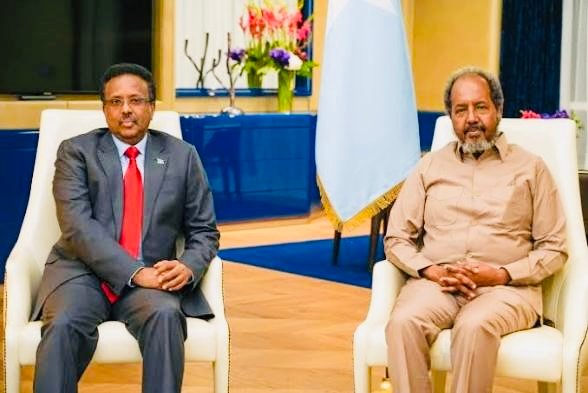
MOGADISHU, Tuesday — Former Somali President Mohamed Abdullahi Mohamed, widely known as Farmaajo, has renewed his call for a fully inclusive and nationally agreed electoral process in Somalia, warning that any move toward unilateral elections could undermine political stability in the Horn of Africa nation.
In a statement issued in Mogadishu on Tuesday, Farmaajo reiterated his longstanding position on Somalia’s contested electoral framework, stressing that credible elections must be based on consensus among all key political stakeholders, including the federal government, federal member states, and broader political actors.
He argued that Somalia cannot afford to proceed with what he described as a “partial or exclusionary” electoral process, insisting that legitimacy can only be achieved through dialogue, consultation, and mutual agreement among all sides.
“Somalia cannot hold a meaningful election without the participation and agreement of all relevant stakeholders,” he was quoted as saying, underlining the importance of national consensus in resolving recurring political disputes.
The former president’s remarks come at a time when Somalia continues to face deep divisions over its electoral model, a long-standing issue that has repeatedly strained relations between the federal government in Mogadishu and regional member states.
For years, Somalia has relied on indirect electoral systems based on clan representation, largely due to persistent insecurity, weak state institutions, and limited government control over parts of the country.
Efforts to transition toward a more direct, one-person-one-vote electoral system have repeatedly faced delays, with disagreements emerging over legal frameworks, voter registration mechanisms, and power-sharing arrangements.
Farmaajo’s comments are widely interpreted as a renewed call for a negotiated political settlement, as Somalia continues to struggle to define a unified and broadly accepted electoral roadmap for upcoming political cycles.
Political analysts say disputes over electoral processes have become one of the main drivers of political instability in Somalia, often triggering standoffs between federal authorities and regional administrations.
These tensions have historically intensified during election periods, with competing political blocs frequently clashing over timelines, procedures, and the composition of electoral commissions.
The former president has consistently urged Somali leaders to prioritize unity, constitutional clarity, and inclusive dialogue, warning that unilateral decisions risk deepening mistrust among political actors and communities.
Observers note that Somalia’s fragile political environment makes consensus-building essential, particularly as the country continues to face ongoing security threats from armed insurgent groups alongside governance challenges.
As Somalia prepares for future electoral transitions, calls for a broadly accepted and inclusive process remain central to political debates, with Farmaajo’s latest remarks adding renewed pressure for dialogue and compromise among stakeholders.
The statement is expected to further fuel ongoing discussions over how Somalia can move toward a stable, credible, and universally accepted electoral system capable of strengthening national cohesion and long-term political stability.