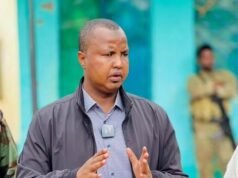
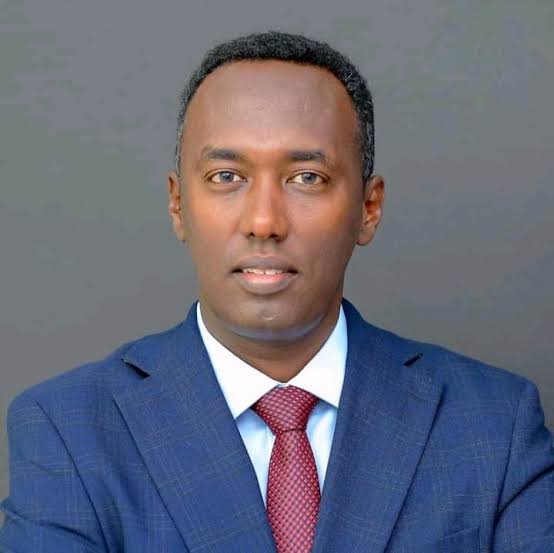
GAROWE — Somali politician and Puntland opposition figure Dr. Guled Salah Barre has sharply criticized Puntland President Said Abdullahi Deni, arguing that the people of Puntland are facing increasing political isolation and limited space for meaningful public participation.
In remarks addressing the political situation in Puntland, Guled described the current circumstances as similar to people being kept in a “dark room,” arguing that the region has become increasingly isolated from wider political developments.
Guled’s comments reflect broader criticism from Puntland opposition figures who have questioned the direction of the administration, its governance policies and its relations with political actors inside and outside Puntland.
Criticism of Puntland’s Political Direction
Guled has been a prominent critic of President Deni. He previously competed against Deni in the 2024 Puntland presidential election, in which Deni was re-elected by the Puntland Parliament.
Since then, Guled has continued to raise concerns about governance, accountability, political participation and the management of Puntland’s public resources.
In previous statements, he accused the Puntland administration of failing to adequately protect the region’s economic interests and alleged that natural resources in areas of Puntland were being exploited without sufficient public oversight. Those allegations have been disputed and should be understood as the claims of a political opponent rather than independently established facts.
Concerns Over Political Isolation
In his latest remarks, Guled argued that Puntland is experiencing a form of political isolation, saying that ordinary citizens have limited opportunities to influence decisions affecting their future.
His description of Puntland as being in a “dark room” was used to emphasize what he sees as a lack of transparency and political openness.
The comments come amid continuing debates over Puntland’s political direction, its relationship with Somalia’s federal government and the future of democratic institutions in the federal member state.
Guled has frequently advocated for stronger democratic institutions and accountability. His background includes serving as chairman of the Transitional Puntland Electoral Commission (TPEC) between 2019 and 2022 and previously serving as Puntland’s Minister of Environment and Climate Change.
A Long-Running Political Dispute
The disagreement between Guled and President Deni is not new. Their political rivalry became particularly visible during the 2024 Puntland presidential election, when Guled challenged Deni for the presidency.
The election was conducted through Puntland’s parliamentary system, with lawmakers ultimately re-electing Deni after three rounds of voting. Guled secured 21 votes in the final round.
Since the election, political disagreements have continued over issues including governance, economic management, federal relations and the development of democratic institutions.
Guled’s recent criticism therefore forms part of a wider political debate rather than an isolated disagreement.
Questions Over Governance and Resources
Guled has also previously raised concerns over the management of Puntland’s natural resources, particularly in the Sanaag and Bari regions.
In May 2025, he accused the Deni administration of allowing foreign companies and security contractors to exploit natural resources without adequate public oversight. The allegations were reported by several Somali media outlets, but they remain political accusations and have not been established as facts by an independent investigation.
He has also argued that economic difficulties, unemployment and the migration of educated young people are among the challenges facing Puntland.
Broader Political Context
Puntland continues to navigate complex political questions involving its internal governance, relations with Somalia’s federal institutions and debates over the future of federalism and democratic representation.
Guled has written and spoken extensively about federalism and Puntland’s democratic transition. His recent public commentary continues to emphasize political accountability, institutional reform and greater public participation.
The Puntland administration has its own position on these political and governance issues, and supporters of President Deni have defended his administration’s policies and record.
As political debate continues, Guled’s latest remarks are likely to add to discussions about governance, political inclusion and Puntland’s relationship with the wider Somali federal system.
The statements attributed to Guled Salah Barre represent the position of a political opposition figure. Claims concerning governance, resource exploitation and political isolation should therefore be distinguished from independently verified facts.