
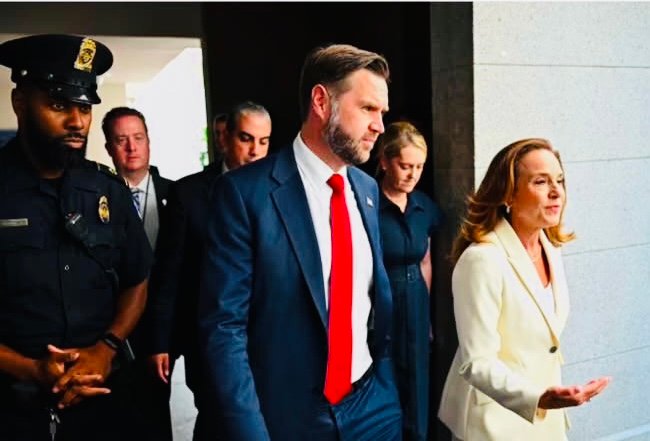
WASHINGTON – US Vice President JD Vance has drawn attention after making unusually direct comments on sensitive issues involving the war in Iran, political influence in Washington, and the long-running controversy surrounding the files linked to convicted sex offender Jeffrey Epstein.
Vance’s remarks have attracted significant public interest because they touch on issues that senior US officials have often approached with caution, particularly discussions involving the influence of foreign governments, intelligence agencies, and powerful political networks.
Speaking about the ongoing debate over US policy toward Iran, Vance claimed that some individuals connected to Israeli political circles were attempting to influence American public opinion in favor of continuing military action against Tehran.
“There is no doubt that there are people within the Israeli system who are trying to influence American public opinion in order to continue the war with Iran indefinitely,” Vance was quoted as saying.
The comments have sparked debate in Washington, with supporters arguing that Vance was raising legitimate questions about foreign policy influence, while critics accused him of promoting unsubstantiated claims and increasing tensions around a highly sensitive geopolitical issue.
Vance also addressed the controversy surrounding the Jeffrey Epstein files, criticizing what he described as insufficient transparency regarding the release of information connected to Epstein’s activities and his network of influential contacts.
Epstein, a wealthy financier who died in a US jail in 2019 while awaiting trial on federal sex trafficking charges, had relationships with numerous prominent figures from politics, business, and entertainment. The release and handling of documents connected to his case have continued to generate public debate and conspiracy theories.
When asked about claims circulating that Epstein may have had links to intelligence organizations, including Israel’s Mossad or the US Central Intelligence Agency (CIA), Vance responded by naming several possibilities.
“Yes, Mossad or the CIA or another secret intelligence agency,” Vance said, while discussing the allegations.
He added that Epstein had “clear connections” with powerful circles in US and Israeli political and intelligence environments.
However, there is currently no publicly verified evidence proving that Epstein worked for Mossad, the CIA, or any other intelligence organization. Such claims have circulated widely online and in political discussions but have not been confirmed by official investigations or intelligence agencies.
The White House and intelligence officials have not publicly confirmed Vance’s claims regarding Epstein’s alleged intelligence connections.
The remarks come amid broader political debates in the United States over foreign policy, America’s role in Middle East conflicts, relations with Israel, and demands from some groups for greater transparency regarding government documents.
Analysts say Vance’s comments reflect growing divisions within American politics over foreign intervention, national security policy, and the influence of international alliances on US decision-making.
The controversy highlights the increasingly polarized debate in Washington over how the United States should manage its relationships with allies, respond to conflicts abroad, and address public demands for accountability and transparency.