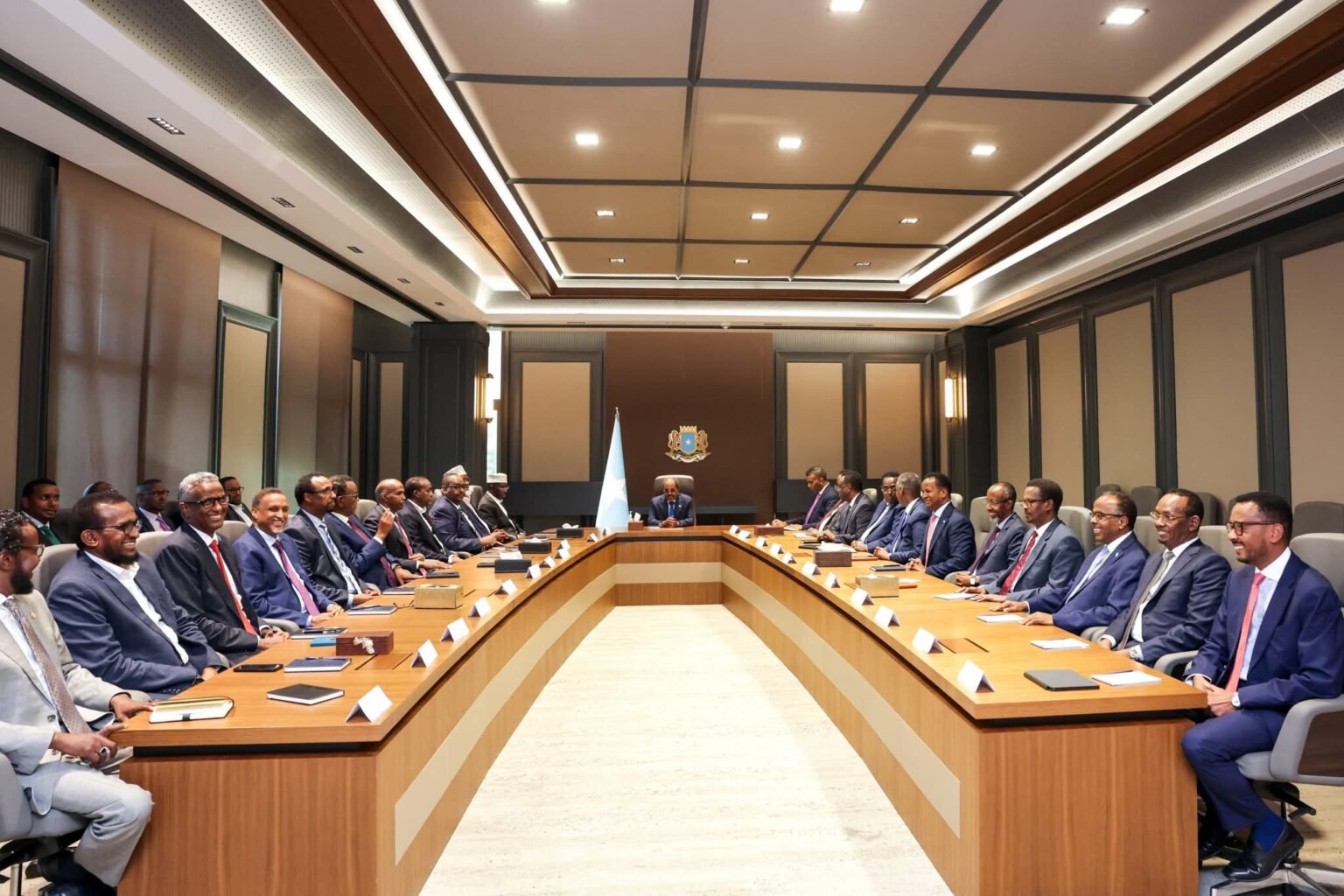
MOGADISHU — High-level negotiations underway at the heavily fortified Halane Compound in Mogadishu are emerging as a decisive moment in Somalia’s increasingly strained political transition, with leaders from the Federal Government of Somalia and the Somali Future Council attempting to narrow deep divisions over the country’s electoral roadmap.
The talks bring together key national and regional stakeholders, including representatives linked to Puntland and Jubbaland, at a time when the federal government’s mandate is nearing expiry and political uncertainty is rising sharply. The compressed timeline has turned the meeting into more than a negotiation on elections — it is effectively a test of whether Somalia’s federal system can still produce consensus under constitutional pressure.
At the center of the deadlock is the contested shift toward a direct universal suffrage model, or one-person-one-vote system. The federal government continues to frame the model as a long-overdue democratic milestone that would expand voter participation and strengthen legitimacy. However, opposition actors and several federal member states argue that Somalia’s current security environment, administrative capacity, and voter registration systems are insufficient to support such a transition within the proposed timeframe.
This disagreement is not only technical but also political in nature. The electoral model has become a proxy for broader disputes over power distribution between Mogadishu and federal member states, as well as competing interpretations of constitutional authority during transitional periods. The involvement of regional actors such as Puntland and Jubbaland underscores the extent to which Somalia’s electoral debate remains deeply federalized rather than purely national.
The Somali Future Council is expected to present a compromise proposal that reportedly explores a phased or hybrid electoral system. While details remain unclear, the emerging logic appears to be an attempt to balance the federal government’s push for direct elections with the opposition’s concerns over feasibility and security. Whether this proposal gains traction will depend largely on whether it is perceived as a genuine bridge or a tactical delay mechanism.
International engagement, including facilitation from the United States Embassy in Somalia, reflects growing concern that a breakdown in talks could quickly escalate into a governance crisis. External actors are not directly shaping the outcome, but they are exerting diplomatic pressure to prevent unilateral decisions that could deepen institutional fragmentation.
The stakes extend beyond the immediate electoral calendar. If the talks fail, Somalia could face overlapping legitimacy claims, strained federal-regional relations, and a weakened constitutional order at a sensitive moment in its post-transition political development. Such an outcome would likely complicate security coordination and governance at both national and regional levels.
However, even a successful agreement would not resolve all underlying tensions. Analysts note that Somalia’s electoral disputes are recurring because they are rooted in unresolved questions about federal authority, resource distribution, and constitutional interpretation. As a result, any deal reached in Halane is likely to be viewed as temporary stabilization rather than a final settlement.
For now, the Halane negotiations represent a narrow but significant window for compromise. The outcome will likely shape not only the immediate electoral timetable, but also the broader trajectory of Somalia’s federal experiment in the months ahead.