KAMPALA / MOGADISHU – The Uganda Law Society (ULS), one of the leading professional associations representing lawyers in East Africa, has publicly called on Somali President Hassan Sheikh Mohamud to respect and implement the decisions of Somalia’s Supreme Court amid the country’s escalating constitutional and political crisis.
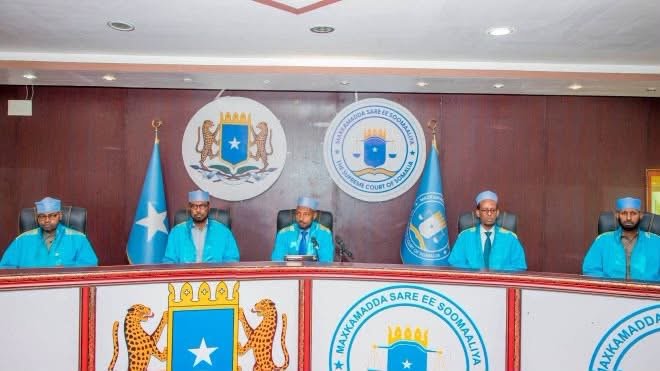
In a strongly worded statement released on Tuesday, November 10, the association urged President Hassan Sheikh to comply with the Supreme Court’s rulings concerning the expiration of his presidential mandate and the dismissal of Chief Justice Baashe Yusuf Ahmed.
The lawyers emphasized that the president must respect the authority of the country’s highest judicial institution and uphold constitutional principles, judicial independence and the rule of law.
The association’s intervention comes as Somalia faces growing political tensions over the legitimacy of the president’s continued stay in office following the Supreme Court’s November 5 decision.
Lawyers Say Presidential Mandate Has Expired
The Uganda Law Society referred to the Supreme Court’s ruling that President Hassan Sheikh Mohamud’s four-year presidential mandate expired on May 15, 2026.
The court also determined that the mandates of both houses of the Federal Parliament expired on April 14, 2026.
The Supreme Court ruled that constitutional amendments extending the terms of elected institutions from four to five years could not automatically be applied to officials who were already serving their mandates.
It subsequently directed political stakeholders to agree on an electoral framework within 30 days and conduct elections within 90 days.
The court further stated that the federal government should operate in a caretaker capacity, with its authority restricted to routine administrative responsibilities pending an agreed electoral process.
Uganda Law Society Warns Against Undermining Judicial Independence
The association expressed serious concern over the confrontation between Somalia’s presidency and judiciary, particularly following President Hassan Sheikh’s decision to dismiss Chief Justice Baashe Yusuf Ahmed.
The Supreme Court subsequently declared the dismissal unconstitutional and null and void.
The lawyers stressed that judicial institutions must be protected from political interference and that government officials are equally subject to constitutional and legal obligations.
The association also highlighted Uganda’s long-standing military involvement in Somalia, recalling that Ugandan troops were the first to deploy under the African Union Mission in Somalia (AMISOM) in March 2007.
It argued that Uganda’s sacrifices in Somalia were intended not only to restore security but also to help establish a country founded on peace, democratic governance, human rights and the rule of law.
Somalia Urged to Respect East African Community Principles
The Uganda Law Society also reminded Somalia of its obligations as a member of the East African Community (EAC).
It specifically referred to Articles 6(d) and 7(2) of the EAC Treaty, which require member states to uphold democracy, accountability, good governance, human rights and the rule of law.
The association called on the East African Community, the African Union and the international diplomatic community to engage Somalia’s leadership and encourage compliance with constitutional and regional legal obligations.
Chief Justice Baashe Welcomes the Statement
Chief Justice Baashe Yusuf Ahmed welcomed the Uganda Law Society’s intervention, thanking the association for publicly defending Somalia’s Constitution and judicial independence.
In a statement shared on social media, Baashe described the intervention as an important demonstration that constitutionalism and the rule of law are shared African responsibilities.
Political Crisis Deepens
The intervention by the Uganda Law Society adds an important regional dimension to Somalia’s ongoing political crisis.
The federal government, however, has challenged the Supreme Court’s decision. The Office of the Attorney General rejected the November 5 ruling, questioning the court’s jurisdiction and the legal standing of former President Sharif Sheikh Ahmed, who filed the constitutional petition.
The disagreement has further intensified tensions between the presidency, opposition leaders and judicial institutions.
The central issue now is whether Somalia’s political leadership will respect the Supreme Court’s decision and pursue an electoral agreement through inclusive dialogue, or whether the constitutional dispute will continue to deepen the country’s political divisions.