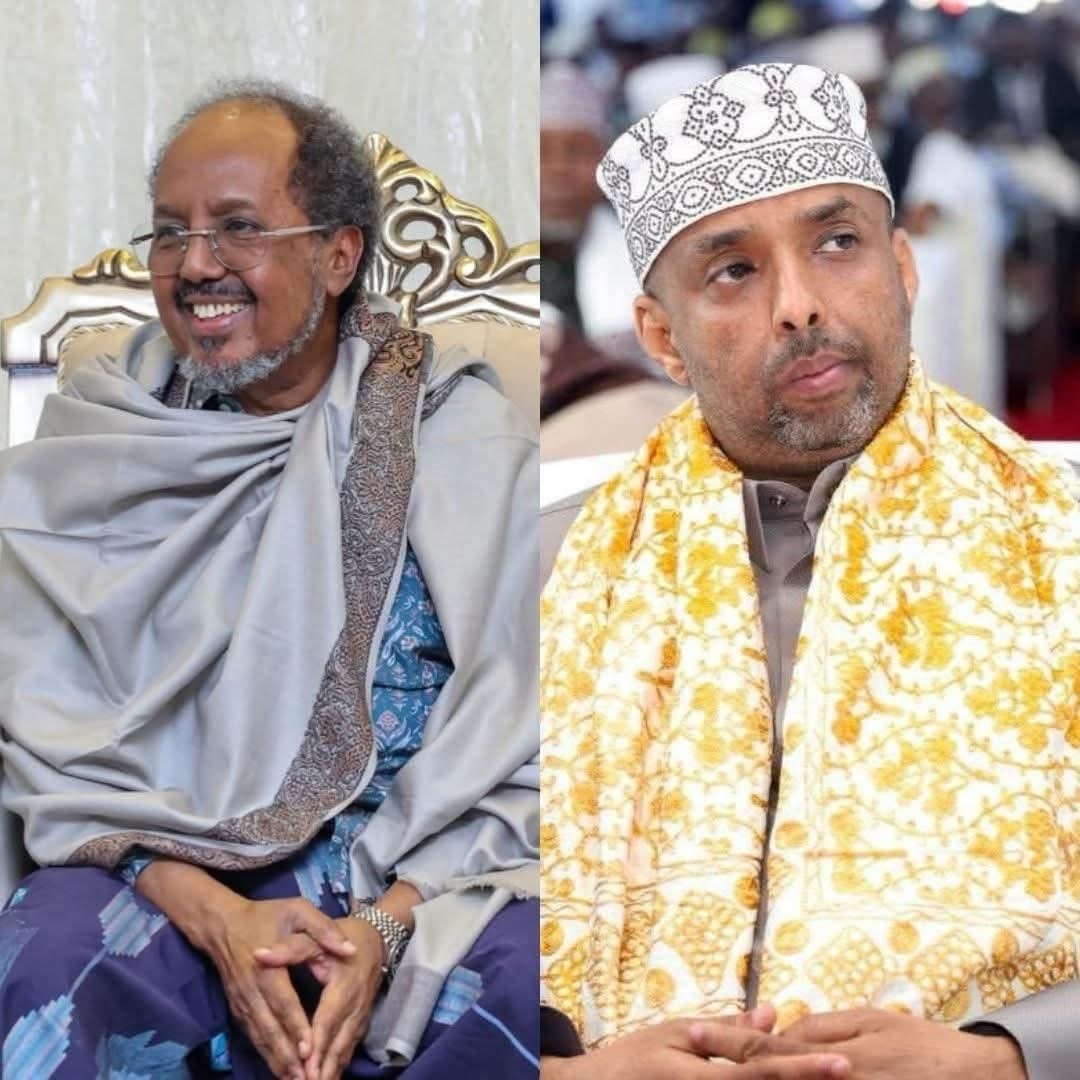
MOGADISHU — Highly reliable sources have confirmed that a sensitive, high-level political consultation is being arranged at Villa Somalia between Somali President Hassan Sheikh Mohamud and Hawadle traditional leader Ugaas Yusuf Ugaas Hassan Ugaas Khalif, in what is being described as one of the most consequential behind-the-scenes political engagements in recent months.
The talks are expected to center on intensive consultations regarding a possible leadership change in the Hirshabelle regional state, amid growing political dissatisfaction both within federal circles and among local communities in Hiiraan and Middle Shabelle regions.
According to multiple sources familiar with the discussions, the Federal Government is increasingly concerned about persistent governance challenges in Hirshabelle, including weak institutional capacity, recurring political disputes, and unresolved clan power-sharing tensions that have repeatedly undermined administrative stability. The meeting is therefore being framed not as a routine consultation, but as part of a broader political recalibration aimed at stabilizing one of Somalia’s most strategically important federal member states.
Preliminary understandings are reportedly emerging around the possibility of supporting a senior leadership candidate from the Hawadle community for a top position within Hirshabelle’s leadership structure. However, sources caution that the situation remains highly sensitive. The Hawadle community itself is said to be internally divided over strategy—particularly whether to pursue engagement with the current regional leadership or push more firmly for a complete restructuring of the administration. These internal divisions are expected to play a critical role in shaping the final outcome of the talks, as federal mediation efforts attempt to balance competing political and clan interests.
Hirshabelle, formed in 2016 as one of Somalia’s federal member states, has long been described by political observers as one of the most institutionally fragile administrations in the country. Critics argue that since its creation, the state has struggled with weak administrative institutions and limited service delivery, repeated leadership disputes and contested political agreements, persistent allegations of clan-based power concentration, and a lack of stable and inclusive governance structures. These issues have contributed to a cycle of political instability, with frequent tensions between major communities—particularly the Hawadle and Abgaal—shaping the region’s political environment.
Political analysts suggest that the involvement of Villa Somalia at this level signals a more assertive federal approach to stabilizing Hirshabelle, especially at a time when national priorities include security consolidation and electoral preparations. Some observers view the talks as an attempt to pre-empt further escalation of local tensions, while others interpret them as part of a broader negotiation process involving power-sharing adjustments among key political actors in central Somalia. Opposition figures, however, remain skeptical, arguing that repeated elite-level negotiations have historically failed to produce sustainable reforms unless accompanied by broader institutional restructuring and transparent governance mechanisms.
If successful, the ongoing consultations could mark a significant turning point in Hirshabelle’s political trajectory, potentially leading to a reshaping of the regional leadership structure, reduced tensions between Hawadle and Abgaal communities, strengthened federal influence in regional stabilization efforts, and a new political settlement in central Somalia. However, analysts also warn that any perceived imbalance in the process could risk deepening existing divisions, particularly if key local stakeholders feel excluded from the final arrangements.
As discussions continue behind closed doors, the outcome remains uncertain. What is clear, however, is that the stakes are high—not only for Hirshabelle’s immediate leadership future, but also for the broader question of federal-state relations and political stability in Somalia at a critical juncture.