
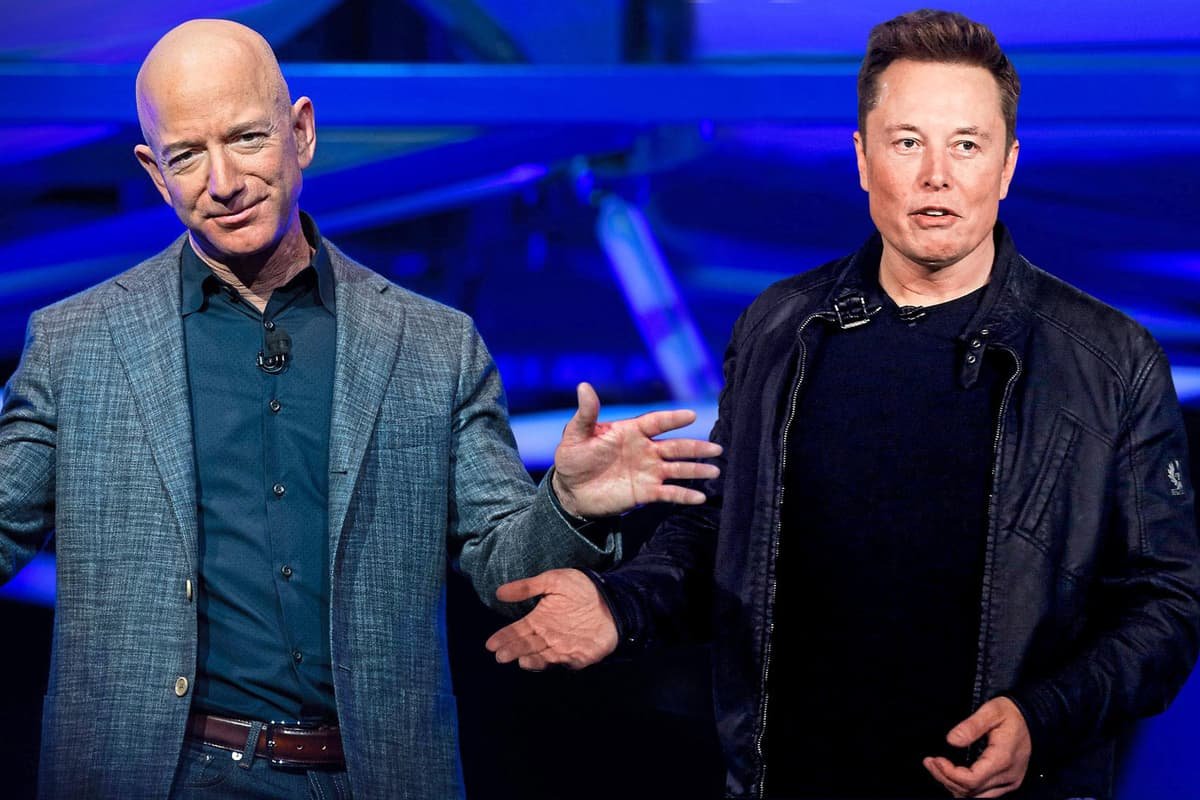
NAIROBI — The long-running rivalry between US tech billionaires Elon Musk and Jeff Bezos is expanding into Africa, with Amazon’s satellite internet project, Project Kuiper, reportedly planning its first African gateway in Kenya, a move that would place it in direct competition with Starlink’s already established presence in the country.

The development underscores Africa’s growing role in the global race to control satellite-based internet infrastructure, as technology giants compete to connect underserved regions through low-Earth orbit (LEO) networks.
Starlink, operated by Elon Musk’s SpaceX, has rapidly expanded across parts of Africa, offering high-speed internet in rural and remote areas where traditional broadband infrastructure remains limited. Amazon’s Project Kuiper, still in the early stages of global deployment, is now positioning itself as a rival system targeting similar emerging markets.
Kenya, one of Africa’s most advanced digital economies, has emerged as a strategic entry point for global technology firms. The country is widely regarded as a regional tech hub, with a strong mobile money ecosystem, growing data infrastructure, and increasing foreign investment in its digital sector.
Analysts say the planned expansion reflects a broader geopolitical shift in which digital infrastructure is becoming a key arena of global competition.
Satellite internet systems are increasingly seen as critical infrastructure, not only for commercial connectivity but also for communications resilience, data access, and strategic influence in developing regions.
The presence of competing US-based satellite networks in Africa is also raising questions about long-term dependency on foreign-owned digital systems, particularly in countries where domestic satellite capacity remains limited.
Digital policy experts warn that while satellite internet can significantly improve connectivity in underserved areas, heavy reliance on external providers may create vulnerabilities in pricing control, data governance, and national digital sovereignty.
Some analysts argue that African governments must balance the benefits of rapid connectivity with investments in local infrastructure and regional technology initiatives to avoid long-term dependence on external networks.
Others say partnerships with global technology companies remain essential, particularly as governments seek to expand internet access in rural and remote areas where infrastructure costs remain high.
Kenya’s position at the center of this emerging competition highlights its importance as a gateway for digital expansion into East Africa.
The country has already attracted major global technology firms and continues to position itself as a leading innovation hub on the continent.
If confirmed, Amazon’s entry into Kenya’s satellite internet ecosystem would intensify competition with Starlink and further cement the country’s role in shaping Africa’s digital future.
Beyond corporate rivalry, the competition between Musk and Bezos reflects a broader global struggle over control of next-generation communication systems.
As Africa becomes a key frontier for satellite internet expansion, the continent is increasingly positioned at the intersection of technological innovation, economic opportunity, and strategic influence.
For now, Kenya stands at the center of this unfolding contest — one that could help determine who controls the infrastructure of Africa’s digital age.