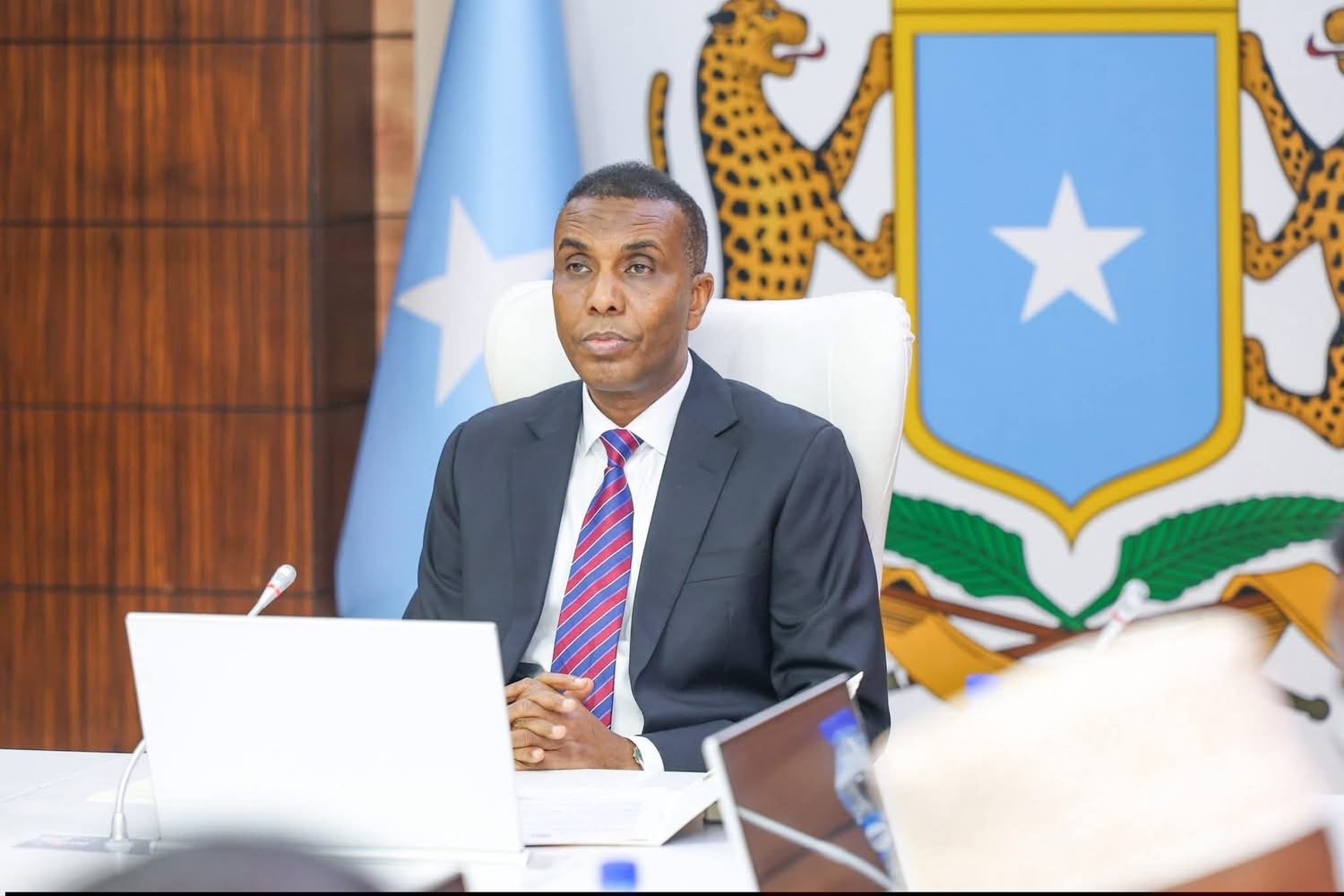
MOGADISHU — Hamza Abdi Barre has said Somalia’s revised constitution is legally in force from the moment it was signed by Hassan Sheikh Mohamud and published in the official government gazette, but warned that full implementation will require time, coordination and technical preparation.
Speaking in Mogadishu on Saturday, the prime minister clarified that while the constitutional text now has legal effect, its practical application across government institutions will be gradual and dependent on administrative readiness.
He noted that several provisions — particularly those related to governance structures, federal arrangements, and public administration — cannot be implemented instantly without supporting regulations, institutional reforms and agreements between federal and regional authorities.
Hamza said the constitution represents a major milestone in Somalia’s long-running state-building process, describing it as a framework intended to guide political stability, institutional development and the transition toward a more structured governance system.
However, he emphasized that legal adoption does not automatically translate into immediate operational change. “The constitution is in force, but its implementation is a process,” he said, highlighting the need for phased rollout and technical alignment across government bodies.
The prime minister’s remarks come amid continued political debate over Somalia’s constitutional amendments and electoral reforms. Opposition figures have questioned both the process and timing of the changes, arguing that key reforms have been advanced without broad national consensus.
The federal government, however, insists that the constitutional framework is now legally binding and that remaining steps are procedural and administrative rather than political.
The issue remains central to Somalia’s ongoing political transition, as the country attempts to finalize its constitutional order while also managing disputes between the federal government, opposition groups and federal member states over elections, power-sharing and governance arrangements.