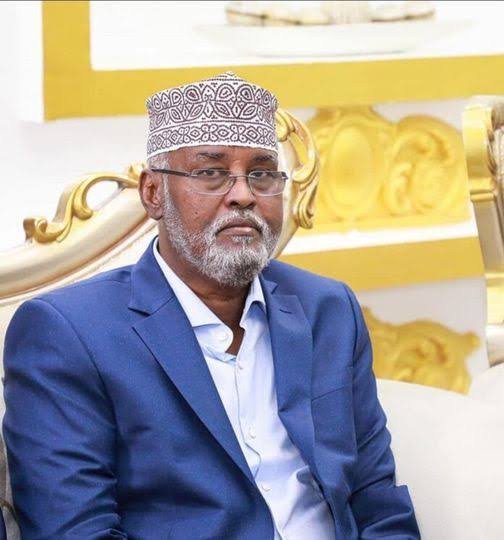
KISMAYO/DOLOW — A deepening political rift within Somalia’s semi-autonomous Jubaland state has raised fresh concerns over stability in a region central to the fight against Islamist insurgents, with sources describing an extraordinary move by the regional leader against his own deputy.
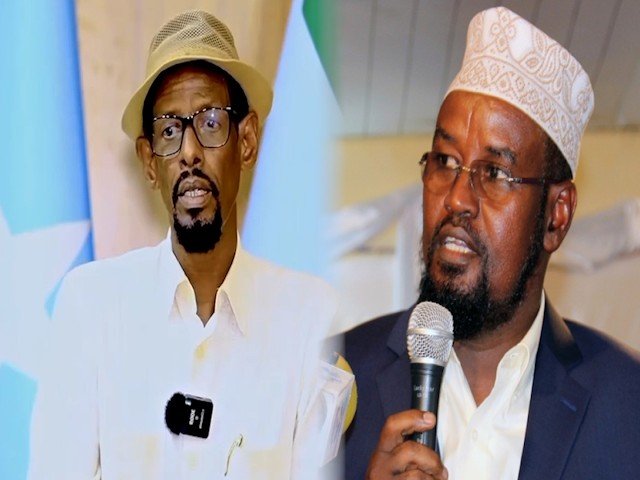
Multiple officials and local sources say Jubaland President Ahmed Mohamed Islam (Ahmed Madobe) has ordered the arrest of his first vice president, Mahmoud Sayid Aden, who is currently believed to be in the border town of Dolow, straddling Somalia and Ethiopia.
The reported directive, which has not been publicly confirmed by the presidency, marks a dramatic escalation in tensions that analysts say reflect deeper fractures within Jubaland’s political structure.
The dispute appears to stem from disagreements over governance, political authority, and relations with Somalia’s federal government. Once considered a close ally of Madobe, Aden is now seen by insiders as increasingly estranged from the regional leadership.
“He was part of the inner circle, but something has clearly shifted,” said a Jubaland-based political observer, speaking on condition of anonymity due to the sensitivity of the matter. “This is no longer a quiet disagreement — it is an open confrontation.”
Sources indicate that Aden had been summoned to return to Kismayo, Jubaland’s administrative capital, but declined. His refusal has fueled speculation that he may be seeking closer ties with authorities in Mogadishu — a move that could further inflame tensions between the regional state and the federal government.
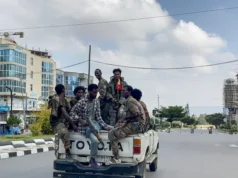
Dolow, where Aden is said to be staying, is a strategically significant town along the Somalia-Ethiopia border, serving as a key commercial and security corridor. Its location makes it a sensitive point in regional geopolitics, particularly amid ongoing security operations and cross-border coordination.
A local official in the Gedo region said authorities had come under pressure to act but declined to confirm whether any arrest attempt had been made. “The situation is delicate,” the official said. “Any step could have wider consequences.”
The unfolding crisis has reignited criticism of Jubaland’s governance model under Madobe, who has led the region for over a decade. Critics have frequently accused his administration of centralizing power and failing to build inclusive political institutions.
“This crisis exposes structural weaknesses,” said a Somali political analyst based in Nairobi. “There has long been discontent over representation and power-sharing in Jubaland. What we are seeing now is a manifestation of those unresolved tensions.”
The political turmoil comes at a time when Jubaland remains a key frontline in operations against the Islamist militant group Al-Shabaab, which continues to carry out attacks across southern Somalia.
Analysts warn that internal divisions within the regional leadership could undermine security coordination and distract from counterinsurgency efforts. “Any fragmentation at the top risks weakening the security apparatus,” one security expert said.
With no official statements from either Madobe or Aden, the situation remains fluid. Observers say several scenarios are possible, ranging from a negotiated settlement to a deeper political split that could reshape Jubaland’s leadership landscape.
“This is a defining moment,” the Nairobi-based analyst said. “How it is handled will have implications not just for Jubaland, but for Somalia’s federal system as a whole.”