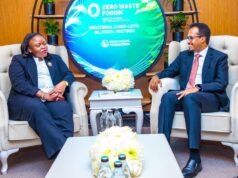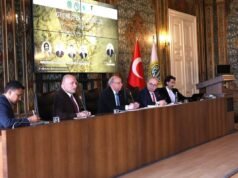
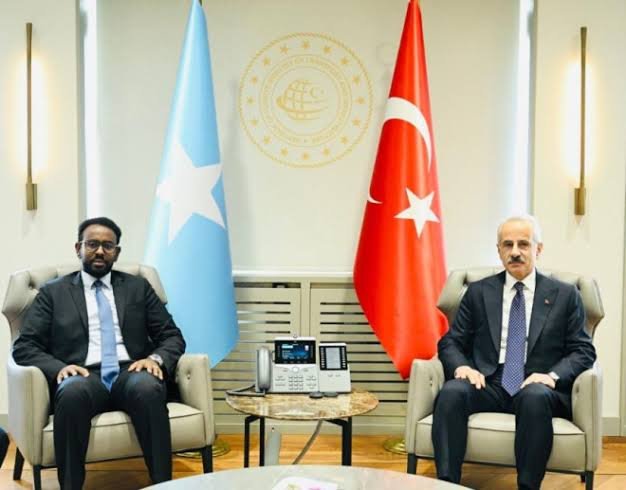
ANKARA — Somalia and Turkey have agreed to deepen cooperation on infrastructure development, housing and urban planning following high-level talks in Ankara on Thursday between Somali Public Works, Reconstruction and Housing Minister Ayub Ismail Yusuf and Turkish Transport and Infrastructure Minister Abdulkadir Uraloglu.
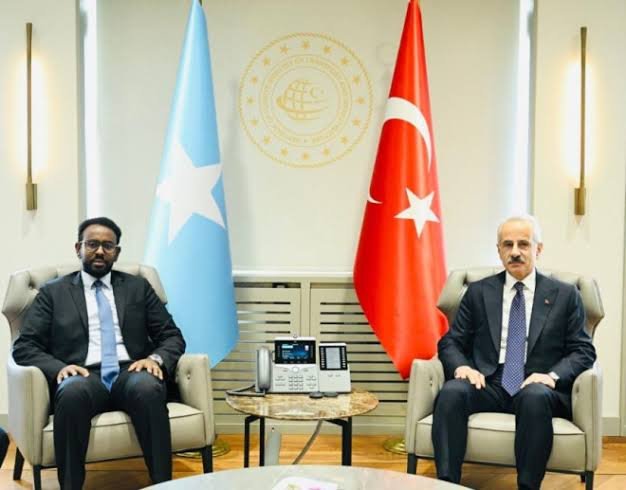
The meeting, held at the headquarters of Ministry of Transport and Infrastructure, brought together senior government officials, engineers, infrastructure planners and technical advisers from both countries as Somalia seeks to accelerate reconstruction efforts after decades of conflict and institutional collapse.
Discussions focused on expanding bilateral cooperation in road construction, housing development, urban planning and technical training, according to officials familiar with the talks.
The ministers also reviewed ongoing and future projects aimed at improving Somalia’s transport network, modernizing urban infrastructure and strengthening construction quality standards.
Uraloglu reaffirmed Ankara’s long-standing support for Somalia’s reconstruction and economic recovery, saying Turkey would continue assisting Mogadishu in transport infrastructure development and institutional capacity-building.
“Turkey remains committed to supporting Somalia’s development journey through infrastructure investment, technical cooperation and knowledge-sharing,” the Turkish minister said during the meeting.
Somalia has increasingly looked to Turkey as a strategic development partner, particularly in infrastructure, education, health services and security cooperation.
Yusuf said Somalia hopes to benefit from Turkey’s engineering expertise and experience in delivering large-scale public infrastructure projects, especially as the Horn of Africa nation seeks to rebuild roads, public facilities and housing systems damaged by years of instability.
The Somali minister proposed the creation of specialized training programs for Somali engineers, urban planners and public works personnel, emphasizing the need to strengthen domestic technical capacity as Somalia expands investment in transport and housing infrastructure.
“Developing skilled Somali engineers and technical professionals is critical for sustaining long-term reconstruction and development,” Yusuf said.
Following the talks, the Somali delegation toured several Turkish government institutions involved in transport planning and infrastructure management.
Officials from General Directorate of Highways briefed Yusuf on Turkey’s national highway management systems, including the planning and maintenance of major road corridors linking key commercial centers across the country.
The delegation also visited highway projects developed under public-private partnership arrangements, where private firms finance, construct and maintain road infrastructure while recovering investment costs through electronic toll collection systems.
Somali officials said the visit provided practical insights into alternative infrastructure financing models that could help Somalia address major funding gaps in road construction and urban development.
Yusuf and his delegation additionally inspected a Turkish state-run vehicle maintenance and fleet management facility, where they reviewed logistics coordination systems, equipment management procedures and vehicle asset maintenance operations.
Turkey has significantly expanded its footprint in Somalia over the past decade, becoming one of Mogadishu’s closest international partners.
Turkish companies and institutions have invested in major infrastructure and development projects in Somalia, including roads, hospitals, schools, port management and humanitarian operations.
Ankara also operates its largest overseas military training facility in Somalia, where thousands of Somali security personnel have received training as part of efforts to strengthen the country’s security institutions.