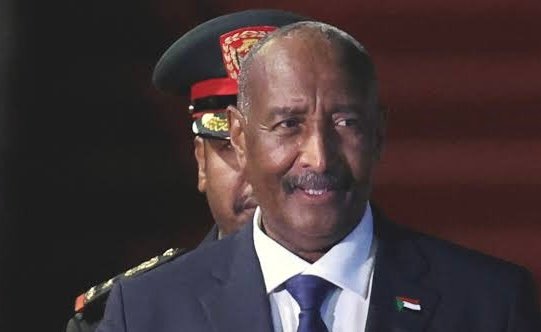
KHARTOUM — Sudan’s army chief and head of the Transitional Sovereignty Council, Gen. Abdel Fattah al-Burhan, has held a series of unannounced consultations with political figures and representatives of civil society as part of efforts to lay the groundwork for a broader national dialogue aimed at addressing the country’s prolonged conflict.
The consultations are reportedly intended to build support for a comprehensive Sudanese-led political process that could help end the war, bridge deep political divisions and establish a framework for the country’s future transition.
The proposed national dialogue is expected to address several critical issues, including ending the conflict, restoring political stability, determining the future structure of the Sudanese state and establishing a framework for a new political transition.
The initiative comes as Sudan remains embroiled in a devastating war between the Sudanese Armed Forces (SAF), commanded by Burhan, and the Rapid Support Forces (RSF), led by Gen. Mohamed Hamdan Dagalo, commonly known as Hemedti. The conflict has fractured the country politically and militarily, while creating severe humanitarian and economic challenges.
Burhan has increasingly emphasized the importance of a political process conducted by Sudanese actors themselves. His position is that Sudanese political forces should have a central role in determining the country’s political future and developing a settlement that reflects national interests.
Recent reports indicate that preparations have been underway for a dialogue involving political parties, civilian representatives, community leaders and other national stakeholders. The aim would be to bring together groups with competing political positions and establish a common framework for resolving the country’s crisis.
However, the initiative faces significant political and practical obstacles. Some civilian political groups have expressed reservations about a dialogue organized or led under military authority. They argue that any credible national dialogue must be sufficiently independent, inclusive and representative of Sudan’s diverse political and social forces.
The Samoud alliance, for example, has reportedly raised concerns about Burhan’s push for an internally organized political process. Such disagreements highlight the broader challenge of creating a dialogue that is accepted as legitimate by both military and civilian actors.
The question of who should participate is likely to be one of the most contentious issues. Sudan’s political landscape remains deeply fragmented, while the war has produced competing alliances, administrations and centres of power. Any process that excludes major civilian, political or armed groups could face questions about its credibility and ability to produce a lasting settlement.
Another major challenge will be reconciling fundamentally different positions on the role of the military in Sudan’s political system. Civilian forces have repeatedly called for a transition toward civilian rule, while the military remains a powerful political and institutional actor.
Meanwhile, regional and international organizations continue to support efforts aimed at finding a political solution to the conflict. The African Union, United Nations and other international partners have engaged Sudanese political groups and emphasized the importance of an inclusive political process alongside efforts to secure a ceasefire and improve humanitarian access.
The proposed national dialogue could therefore represent an important political opening, but its success will depend heavily on whether Sudan’s rival political and military camps can reach agreement on the participants, objectives and structure of the process.
For millions of Sudanese affected by the war, the immediate priority remains an end to the violence, restoration of security, expansion of humanitarian assistance and the creation of conditions for a credible political transition.
Ultimately, any successful national dialogue will need to move beyond political negotiations among elites and address the broader demands of Sudanese society, including accountability, civilian protection, economic recovery, institutional reform and the establishment of a stable and representative government.