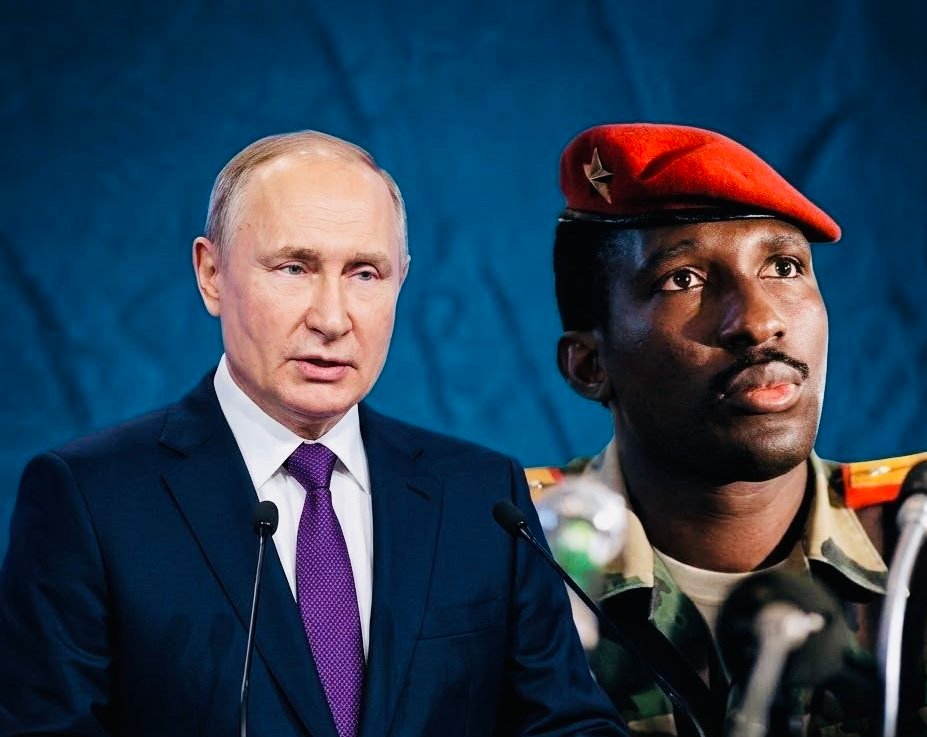
MOSCOW — The debate over Africa’s economic independence and its reliance on foreign debt has resurfaced following reports claiming that Russian President Vladimir Putin paid tribute to Burkina Faso’s revolutionary leader, Thomas Sankara, during the Russia–Africa Summit 2026 in Moscow.
According to the circulating report, Putin recalled Sankara’s 1987 warning that foreign debt could become an instrument of domination, potentially undermining African countries’ economic sovereignty and limiting their ability to determine their own development priorities.
However, the specific claim that Putin referenced Sankara’s message at the summit has not been independently verified.
Sankara’s historic warning about foreign debt
Thomas Sankara, who led Burkina Faso from 1983 until his assassination in 1987, was a prominent advocate of African self-reliance, economic independence and resistance to external domination.
In 1987, Sankara delivered a landmark speech at a summit of the Organization of African Unity in Addis Ababa, Ethiopia, calling on African countries to address the continent’s debt burden collectively rather than confront the challenge individually.
He questioned whether debt repayments were depriving African populations of essential investments in education, healthcare, infrastructure and economic development.
Sankara argued that excessive financial dependence could expose African nations to external pressure, particularly when loan conditions restricted their ability to pursue independent economic policies.
His message continues to resonate in contemporary discussions about debt sustainability, international lending conditions and Africa’s long-term development prospects.
Africa’s continuing struggle for economic independence
Many African countries face significant financial pressures, including high debt-servicing costs, limited access to affordable financing, currency volatility and dependence on commodity exports.
These challenges can place considerable pressure on government budgets, forcing policymakers to balance debt obligations against spending on essential public services and development programmes.
Supporters of debt restructuring argue that African countries need fairer financing arrangements and greater flexibility to invest in their economies. Others emphasize responsible borrowing, stronger public financial management, improved domestic revenue collection and productive investment.
The debate extends beyond whether African countries should borrow. It also concerns the terms of borrowing, the transparency of loan agreements, how borrowed funds are used and whether investments generate sufficient economic and social benefits.
Natural resources and Africa’s economic future
Sankara’s message also raises broader questions about Africa’s control over its natural resources, industrial development and position in the global economy.
Despite the continent’s substantial mineral, agricultural and energy resources, many African economies continue to export raw materials while importing higher-value manufactured goods.
Expanding local processing, strengthening regional trade, investing in technology and education, and developing domestic industries are among the approaches frequently proposed to reduce economic vulnerability.
Greater economic independence also requires effective institutions, transparent governance, investment in infrastructure and stronger cooperation among African countries.
The African Continental Free Trade Area provides a framework for expanding trade within the continent, although financing constraints, infrastructure gaps and other barriers remain significant challenges.
A debate that continues today
The reported reference to Sankara’s ideas has drawn attention to a longstanding question: whether Africa’s financial relationships with international lenders and major economic powers promote sustainable development or risk creating new forms of dependency.
For many supporters of Pan-Africanism, Sankara’s legacy represents a call for African governments to place their populations at the centre of economic policymaking while strengthening national and regional self-reliance.
His message remains relevant to discussions about how African countries can finance development, protect their policy independence and obtain greater value from their natural resources.
Ultimately, the challenge is to secure the investment necessary for economic transformation without allowing unsustainable debt obligations to undermine long-term development priorities.
EDITORIAL NOTE: The claim that Vladimir Putin recalled Thomas Sankara’s warning during the Russia–Africa Summit 2026 has not been independently verified. The reported remarks are therefore presented as an unconfirmed claim, not an established fact.